
Enhancing project outcomes through alternative delivery and collaborative risk sharing
September 19, 2025
CWN’s quarterly newsletter with the latest news, insights, and thought leadership.

In today’s climate of heightened uncertainty and recurring supply chain disruptions, there is an urgent need for infrastructure investment to meet evolving community and environmental demands. How can owners deliver critical municipal projects, often ranging from $500 million to over $1 billion, with confidence in cost-effective and reliable outcomes? The traditional design-bid-build approach is increasingly falling short. Collaborative contracting is gaining traction in many industries, including among municipal leadership and project teams, and for good reasons: it delivers better, more predictable results and higher satisfaction for all key stakeholders.
Spectrum of collaborative contracts
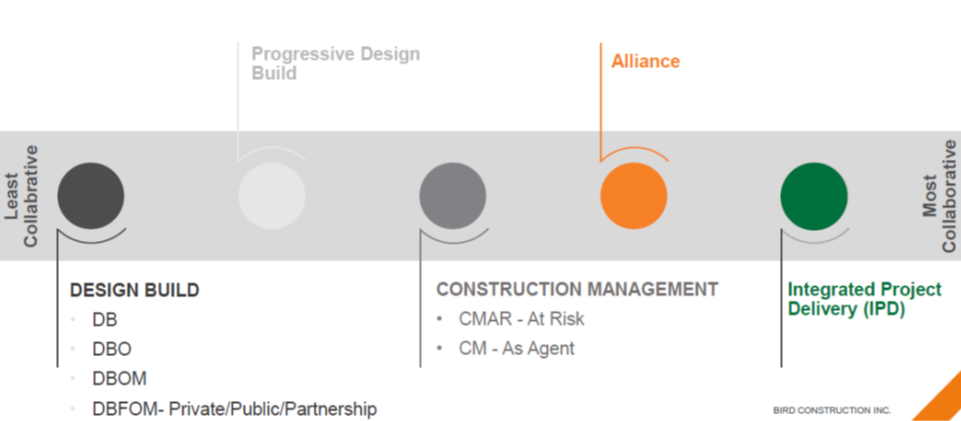
Contracting approaches exist along a spectrum of collaboration, each offering varying levels of outcome reliability. Success with alternative project delivery models depends on using collaborative contract language that incentivizes designers, constructors, and owners to work cohesively. This includes fostering positive team behaviours, building high-performing teams, and deploying balanced risk sharing.
There are varying degrees of collaborative expectations inferred within the different collaborative contract forms, with Integrated Project Delivery (IPD) at the top end of this spectrum. IPD tie key stakeholders together and aligns project partners in making “best for the project” decisions.
Integrated project delivery
IPD is grounded in the principle that all stakeholders are “in this together.” This is reflected in the contract’s structure and key elements:
- Inclusion of behaviour-based language.
- Shared risk and reward.
- Waiver of claims.
- Collective risk management.
- Single multi-party agreement signed by key designers and constructors.
- Clear accountability.
- Requirement to implement lean design and construction.
Owner involvement is critical to project success, especially during the early phases. Active participation from the owner’s project management team, subject matter experts, and operations representatives ensures the team fully understand the owner’s unique goals, requirements, and constraints. While owner engagement continues throughout the project, the intensity typically decreases over time.
Owners report that the overall effort required for IPD is comparable to traditional contracting models. However, the focus of that effort shifts—owners spend more time on value-added activities rather than managing claims and change orders. Research shows that owners are significantly more satisfied with both the final project outcome and the collaborative process on IPD projects, as teams are better able to understand and meet their needs.
The IPD contract model is thoughtfully crafted, combining the best elements of other contract types into a balanced and effective framework.
A balanced view
Although IPD has a strong track record of delivering superior results, it may not be suitable for every project. Key considerations include:
- Is the project straightforward, with low risk or minimal need for innovation?
- Is the organizational or departmental culture collaborative? Are we ready to embrace trusted external partners?
- Is there alignment among project funders and financiers regarding alternative delivery methods and quality-based selection?
- Does the size and criticality of the project justify a change in approach?
- Is there sufficient support from procurement, legal teams, executive management, and Council to proceed with a collaborative contract? Do they understand the model and its benefits?
Many owners face challenges when transitioning from punitive-based contracts to incentive-based models. There is a common misconception that punitive contracts protect against cost and schedule overruns. However, research shows that collaborative contracts offer greater certainty and better outcomes.
Another challenge is that not all non-owner parties are accustomed to full project outcome exposure and the level of transparency required. While designers and trade partners significantly influence project success, they may not be used to the level of total project accountability inherent in IPD. Similarly, general contractors often shield themselves from design risk and process guarantees. IPD breaks down these silos, encouraging multidisciplinary teams to work closely together with transparency and openness to achieve the best project results.
Looking forward
In an era of increasing complexity and uncertainty, alternative project delivery models like IPD offer a compelling path forward for municipal infrastructure projects. By embracing collaboration, shared accountability, and early designer and contractor involvement, these models shift the focus from reactive problem-solving to proactive value creation. While IPD may not suit every project, its proven ability to deliver reliable outcomes, foster stakeholder satisfaction, and align teams around shared goals makes it a powerful tool in the modern contracting landscape. For owners seeking better results and stronger partnerships, the move toward collaborative contracting is not just a trend—it’s a strategic imperative.
This article was sponsored by Bird Construction. To learn more about Bird Construction and its collaborative delivery, visit the company’s website.