
Water Leader Spotlight – Marie-France Witty
September 19, 2025
CWN’s quarterly newsletter with the latest news, insights, and thought leadership.
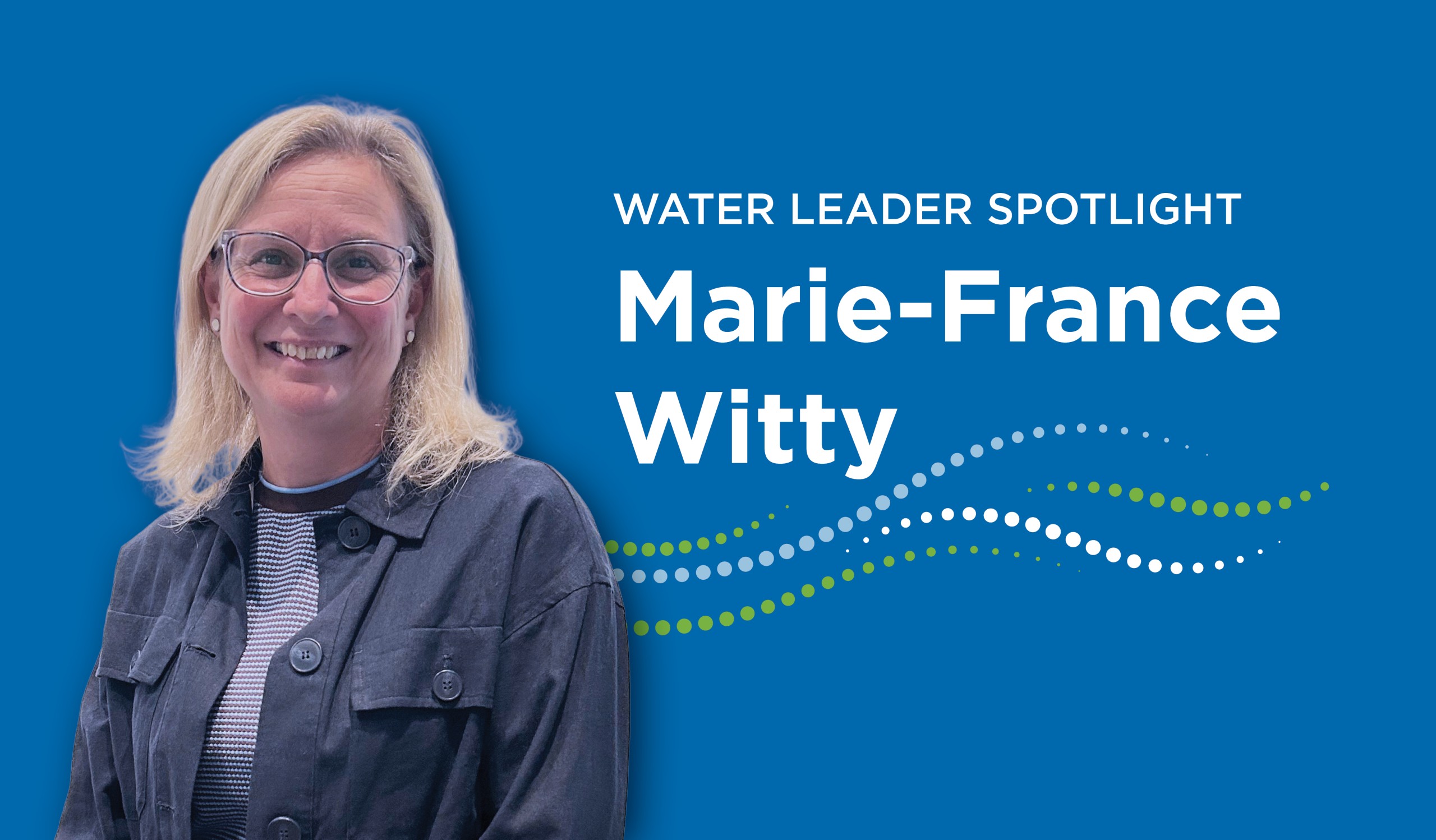
In Canada, we are fortunate to have municipal water leaders from diverse backgrounds serving communities nationwide. Canadian Water Network (CWN) celebrates these outstanding individuals through the Water Leader Spotlight, which aims to recognize and elevate their contributions to the industry by showcasing their career paths and sharing their insights on industry trends.
In our fifth feature, Municipal Water Program Manager Nancy Goucher conducted an in-depth interview with Marie-France Witty. She is the director of strategy and performance for water services at the City of Montreal. Read on to learn about her journey in the water industry.
Can you describe what led you to choose a career in municipal water? What has your career path looked like?
My path into municipal water wasn’t typical—it didn’t begin with engineering, but rather with a foundation in science, economics, and business. These disciplines have shaped how I approach complex decisions in water management, bringing a unique perspective that blends analytical rigour with strategic thinking.
I was trained as a scientist, with a specialty in biochemistry and my master’s degree was in experimental medicine. Like many others, the 2007 financial crisis disrupted my original path. At that time, pharmaceutical companies were downsizing, and I found myself needing to pivot. I moved from Vancouver to Montreal and pursued further studies in business economics, combining my scientific foundation with a growing interest in organizational management and finance.
That combination opened new doors. I was hired as a health economist, which led to a role in workplace safety at Commission des normes, de l’équité, de la santé et de la sécurité du travail (CNESST). This work drew on my expertise in health and public systems. A family decision led to another shift, placing me in a role at the City of Montreal’s water services that required deep knowledge of government operations, finance, and grant funding—areas where my background proved surprisingly relevant.
I never would have thought I’d stay in that role long, but that’s when I discovered how intriguing the world of municipal water really is. It’s a field deeply rooted in science. Chemistry, public health, and environmental management are helpful to know in my role. My financial training has also been incredibly valuable when it comes to tasks such as evaluating the cost-benefit of decisions, which requires solid data and strategic thinking. I realized that water management isn’t just for engineers; it’s a multidisciplinary space where science, economics, and policy intersect.
I’ve now been in the municipal water sector for seven years. My work involves strategic planning, budgeting, and financial sustainability, especially as we face budget cuts and evolving regulations. I’ve found that my background allows me to bridge technical knowledge with financial strategy, helping shape decisions that are both scientifically sound and economically viable.
What do you enjoy most about your work?
What I enjoy most is the variety. For example, after returning from vacation this past week, I am dealing with budget planning, water quality issues, Indigenous relations, and procurement challenges—all within the first few hours of a Monday morning. If you speak to other directors in my department, they’ll tell you the same thing. The scope of our work is incredibly broad.
This kind of diversity in responsibilities means there is room for people with many different areas of expertise. It makes the work dynamic and engaging. You need to thrive in fast-paced environments to succeed here. If you prefer routine and predictability, this may not be the right place for you.
Over time, I’ve had to learn about many areas that are only loosely connected to my core responsibilities. For example, I’ve learned about politics because water is political. It touches on public health, funding, procurement, and regulation. This is something I see clearly in my conversations with members of the Municipal Water Consortium. No one works in isolation. We consistently collaborate with other departments, which requires strategic thinking and strong partnerships.
Our department reflects this diversity. Scientists and engineers tend to be pragmatic and data-driven, which makes them great collaborators. But when managing large teams, you also need people who understand emotion and motivation. A mix of profiles helps us learn from one another and work more effectively.
We also need to be open to new people, new ideas, and new perspectives. That is what keeps our work evolving and responsive to the challenges ahead.
Who has had the most influence on your career?
I’ve learned the most by observing the people around me, especially my directors and supervisors. I ask a lot of questions, sometimes more than people expect, because I’m genuinely curious about how others approach decisions. I pay close attention to how they think, what factors they consider, and how they weigh different options. This process has helped me shape my own decision-making style, which is grounded in a scientific way of thinking. I always ask myself why a decision was made and what its impact might be, and I try to apply the parts that make sense to my own work.
I’ve also been inspired by powerful women in leadership, such as Angela Merkel, former chancellor of Germany, Janet Yellen, former president of the Federal Reserve, and Christine Lagarde, president of the European Central Bank. Water management is still largely a male-dominated field, especially in senior roles, so seeing women lead complex organizations and make high-stakes decisions is motivating. The women I look up to are successful because they are grounded in their community’s concerns and surround themselves with diverse people. They are highly functional and collaborative, regardless of whether their teammates are men or women, dictators or democrats, or rich or poor.
Good decision-making is not just about technical expertise. It is about perspective, curiosity, and learning from others. That is something I carry with me every day.
What are you most proud of in municipal water management? How has this contributed to the organization?
One of the things I am most proud of is the development of the Montreal Water Strategy. While the city had previously identified existing priorities, they needed to be reviewed and aligned under a clear, unified vision. I led the creation of the strategy in collaboration with partners across the organization, building consensus around shared goals. These goals now guide our work over the next 10 years. If we stay on course, we will be able to manage risks more effectively, especially in the face of challenges such as aging infrastructure and the broader goal of building a resilient city. This is the first strategy that has received full buy-in from all the departments that touch water, which is a significant achievement.
The success of the strategy lies not only in the final product but also in the process of developing it. I am proud of what we accomplished together. Early in the process, when speaking with various departments in the city, I discovered they were unaware of their role in complying with regulations, such as new stormwater overflow requirements. Some of their decisions were unintentionally contributing to non-compliance. This conversation highlighted the importance of cross-departmental communication and the need for a shared understanding.
Throughout the strategy development, we engaged with people across the organization and uncovered valuable insights. We realized that while the water infrastructure team may be experts in engineering, other departments also hold critical knowledge about water resources. This was eye-opening for many of my colleagues. It gave each department the agency to act on the aspects of water management that fall within their scope and created a stronger flow of information across the organization.
The process of creating the strategy was incredibly rewarding. It was built through deep collaboration and has helped other departments feel more involved in water management. Now, each team understands how its work contributes to the broader strategy. Everyone can identify their unique role and how it fits into a larger vision.
There is real power in both the process and the outcome. The strategy has united departments around a common goal: to protect and manage one of our most valuable resources.
What positive change have you seen during your career, and what emerging trend do you think water managers should pay attention to?
Over the past seven years, I’ve seen a significant shift in how environmental responsibility is viewed within municipal water management. When I first started, environmental concerns were often seen as separate from our core work. For example, we were investing over $500 million annually in construction, but emissions from trucking, fuel use, and electricity were rarely part of the conversation. Renewable energy and carbon impacts were considered outside our scope.
That has changed. Today, there is growing awareness that water departments play a major role in environmental outcomes. Our responsibility goes beyond treating wastewater — we must also consider the broader environmental footprint of our operations. The concept of net-zero water is gaining traction, and there is a stronger environmental ethic across departments.
This shift is especially visible in how projects are designed. Energy efficiency and carbon footprint are becoming part of the planning process. This is a positive change, and while we are just beginning, there is real potential to do better.
If you had unlimited resources and time, what initiative would you prioritize? If you could have one superpower to advance this work, what would it be?
If I had unlimited resources and time, I would focus on helping people truly understand the value of water. In Quebec, cutting down a tree can make headlines. Yet water, which is just as essential to life, often goes unnoticed until there is a crisis. My goal would be to elevate water in the public consciousness to the same level as other cherished resources —something people value as much as their car, summer vacation, their clothes, or cell phones.
This shift in perception is not only important for the public but also within our own organizations. My role often involves securing buy-in for major decisions, including large infrastructure investments. To do that effectively, I emphasize that we are not just talking about pipes and buildings. We are talking about water. Everyone has a personal connection to water. Whether it’s memories of swimming at the beach, spending time at a chalet, or simply turning on the tap, water is part of our everyday lives. We don’t tap into that emotional connection enough.
As scientists and engineers, we often rely on hard data to make our case, such as cost-benefit analyses, risk assessments, and technical reports. But when we are speaking to people with different responsibilities, we need to find the right angle that resonates with them. Emotional connection can be just as powerful as numbers. That’s how we build support for long-term investments in water infrastructure and sustainability.
This approach helped us gain support for the Municipal Water Strategy, which brought together all major players around a shared goal of protecting our water resources. When people understand the true value of water, they are more willing to take action.
Is there anything about you that might surprise people?
People are often surprised by how much of a nerd I am. I can get completely absorbed in a wide range of topics, from public commissions on IT contracts to Paris fashion week, and even the life of Lise Bissonnette, the former editor of Le Devoir. I’ll watch political hearings with the same intensity others reserve for a Netflix series, and I’m perfectly content reading books on sociology or behavioural economics while relaxing on the beach.
I’m endlessly curious. Nothing feels boring to me, which made school challenging at times because I never wanted to choose just one path. I tend to dive deep into whatever catches my interest, even if it’s outside of things I am directly working on. That curiosity has shaped how I approach problems at work and connect ideas across disciplines. It’s part of what makes my approach to water management unique.
Thank you, Marie-France, for sharing your thoughts with our network.