
Water Leader Spotlight: Iman Hashemi, Ontario Clean Water Agency (OCWA)
December 11, 2025
CWN’s quarterly newsletter with the latest news, insights, and thought leadership.
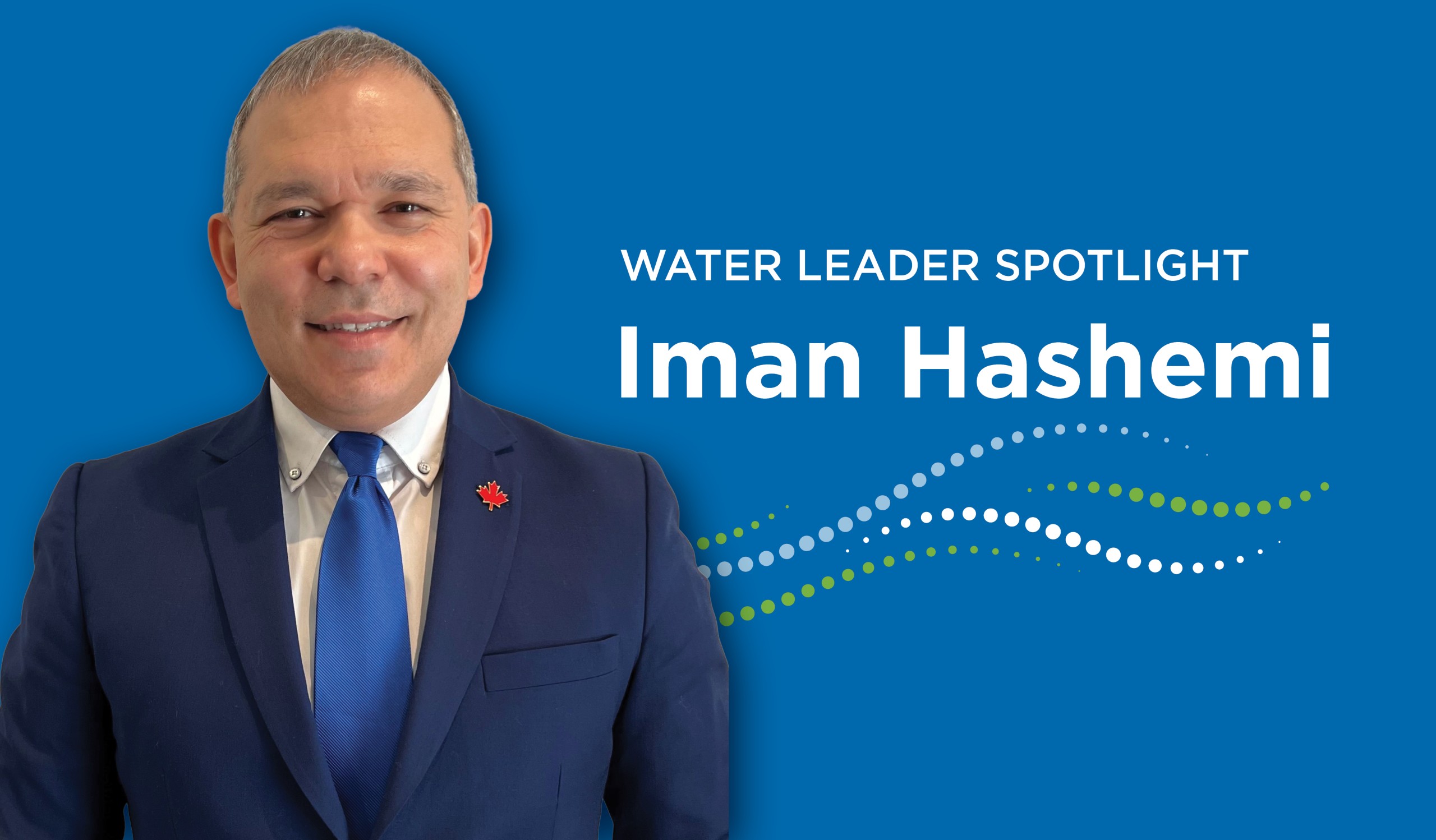
Canadian Water Network’s Water Leader Spotlight celebrates municipal water leaders from across the country by sharing their career journeys and perspectives on industry trends. In this feature, Municipal Water Program Manager Nancy Goucher interviews Iman Hashemi, president and CEO of the Ontario Clean Water Agency (OCWA). The conversation explores his path in the water sector, leadership approach, and insights on the evolving challenges and opportunities shaping the future of water management in Ontario and beyond.
Before he learned the alphabet, Iman Hashemi was reading music. At four years old, he began playing the violin, an experience that taught him discipline and focus early in life. “Music was my first structured learning,” he says. “It showed me the value of practice and precision.” Those lessons shaped his approach to leadership decades later, where technical expertise and human connection are equally important.
Iman is now president and CEO of the Ontario Clean Water Agency (OCWA), an organization that delivers water and wastewater solutions operating over a thousand facilities across the province. His leadership philosophy is clear: solving technical challenges is only part of the job. Building strong teams through unlocking people’s potential to become better and fostering collaboration are equally critical. “The role of a leader is not to manage transactions,” he explains. “It is to manage problems and the grey area and think strategically about the next step in delivering sustainable solutions.”
Iman grew up outside Canada in a household where science, music, and care for society were central topics. His mother, a chemist by training and an educator, encouraged curiosity and learning. When he moved to Canada as a teenager and started Grade 9, priorities shifted. He had to learn English and adapt to a new environment. Music took a back seat, but the discipline and analytical thinking it instilled remained.
A career built on impact
Iman’s career in the water sector spans nearly 20 years. Before joining OCWA in 2011, he worked for Zenon/GE Water as a commissioning field specialist. In that role, he spent over 300 days a year travelling across North America, leading the start-up of municipal, industrial, and First Nations water and wastewater systems. “I felt a deep responsibility to our clients in ensuring that when I left the project, the operators knew how to run the plant well,” he says. Training was a priority because he knew the challenges they would face once he was gone.
His work included major projects such as the Twin Oaks Drinking Water Treatment Plant in San Diego, GE’s largest project in 2008; the Brightwater Wastewater Treatment Facility in King County, Seattle; and the Canadian Natural Resources Limited Horizon Cogeneration facility near Fort McMurray, Alberta. These experiences reinforced the interdisciplinary nature of the sector. “To build infrastructure, you need every discipline,” he explains. “I learned how to work across technical boundaries, engage with people at all levels, and adapt my approach to each team’s language. At times, that meant walking behind my team and clients to support them, walking beside them to work in partnership, and, when needed, stepping ahead to anticipate challenges and opportunities.”
At OCWA, Iman advanced through roles including process and energy optimization specialist, senior operations manager for the Arthur P. Kennedy Water Treatment Plant, and acting water system manager. In 2020, he became vice president of innovation and infrastructure solutions, where he focused on process and energy optimization, asset management, environmental stewardship, and climate change planning. Today, as president and CEO, he works with the agency’s board of directors and executive leaders. Together, they lead strategic initiatives to support provincial mandates ensure the health and sustainability of communities across Ontario by serving as a trusted partner.
The values of collaboration and leadership
Iman emphasizes the collaborative nature of Ontario’s water sector and is a proud representative of the sector. “Ontario is a hub of excellence,” he says. “We work with some of the brightest innovators, engineers, contractors, operators, and consultants to deliver critical infrastructure.” He also values the diversity of OCWA’s clients, from large systems like Peel Region to small northern communities such as Moosonee. “The scalability and diversity keep the work interesting,” he notes. “We support over 200 municipalities in facilitating housing development through our O&M services running their water and wastewater systems and helping them identify and shape their capital projects to ensure health safety.”
Trends in a constantly evolving industry
Over his career, Iman has seen the water sector evolve dramatically. “Innovation used to be seen as a cost center,” he says. “Now it is a way to be more efficient and proactive, not reactive.” This shift supports a broader resource economy lens. “We no longer call them wastewater treatment plants,” he explains. “They are water resource recovery facilities. Waste is a commodity to be leveraged and valued. Ontario has great examples of resource recovery in action.”
Cybersecurity is another area where change has been profound. “Cyber threats are a constant,” Iman says. “OCWA has participated in developing cybersecurity approaches and response plans. It is a journey with varying complexity that is dictated by the size and scale of the community. But across Canada, there is a lot of innovation to do better. Defence and assurance are critical.”
Building resiliency through collaboration is also a growing priority. “Sometimes the issue is not historical data,” he notes. “Many systems do not have much data available, but there is traditional knowledge. Talk to the right people, such as the operators who have been there for years. That is a starting place. A growth mindset matters. The issue is not always about a lack of data preventing decisions.”
Asset management has undergone its own transformation. “Decades ago, we looked at critical infrastructure without considering function and performance,” Iman says. “Now, with regulation and technical expertise, we deliver differently. We look at functional abilities and performance to develop asset management plans and strategies. We not only operate but also support clients with asset management. At OCWA, we manage one of the province’s largest work management systems, where, over the last many years, we have rolled out this system to collect the right data and make informed decisions to prolong the life of our client assets.”
Looking ahead
Iman believes the sector is entering a period of both opportunity and uncertainty. “We have the chance to rework business models to enable collaboration and openness,” he says. “The challenge is doing it responsibly, with deliberate strategy and clear priorities.”
Environmental stewardship is central to his vision. “Protecting the Great Lakes and source water requires a One Water approach,” he explains. “Drinking water and wastewater are connected through source water. Recognizing that circularity is essential.”
Leadership, in his view, means embracing change and demonstrating what is possible. “Organizations do not change unless leaders understand the art of the possible,” he says. “Small actions can create an environment for innovation. Managing relationships and growing people is the foundation of leadership.”
Technology, including artificial intelligence, will play a role. But Iman stresses that tools alone are not enough. “Innovation is about people and relationships,” he says. “We need deliberate adoption and better strategies.”
Conclusion
From Iman’s early years learning music to his current role leading one of Ontario’s most critical agencies, his career reflects a consistent focus on discipline, collaboration, and progress. “At the end of the day,” Iman says, “it is about delivering solutions that matter to the communities that we serve and doing it together.”