
Water leader spotlight: Susan Ancel — EPCOR
April 3, 2026
CWN’s quarterly newsletter with the latest news, insights, and thought leadership.
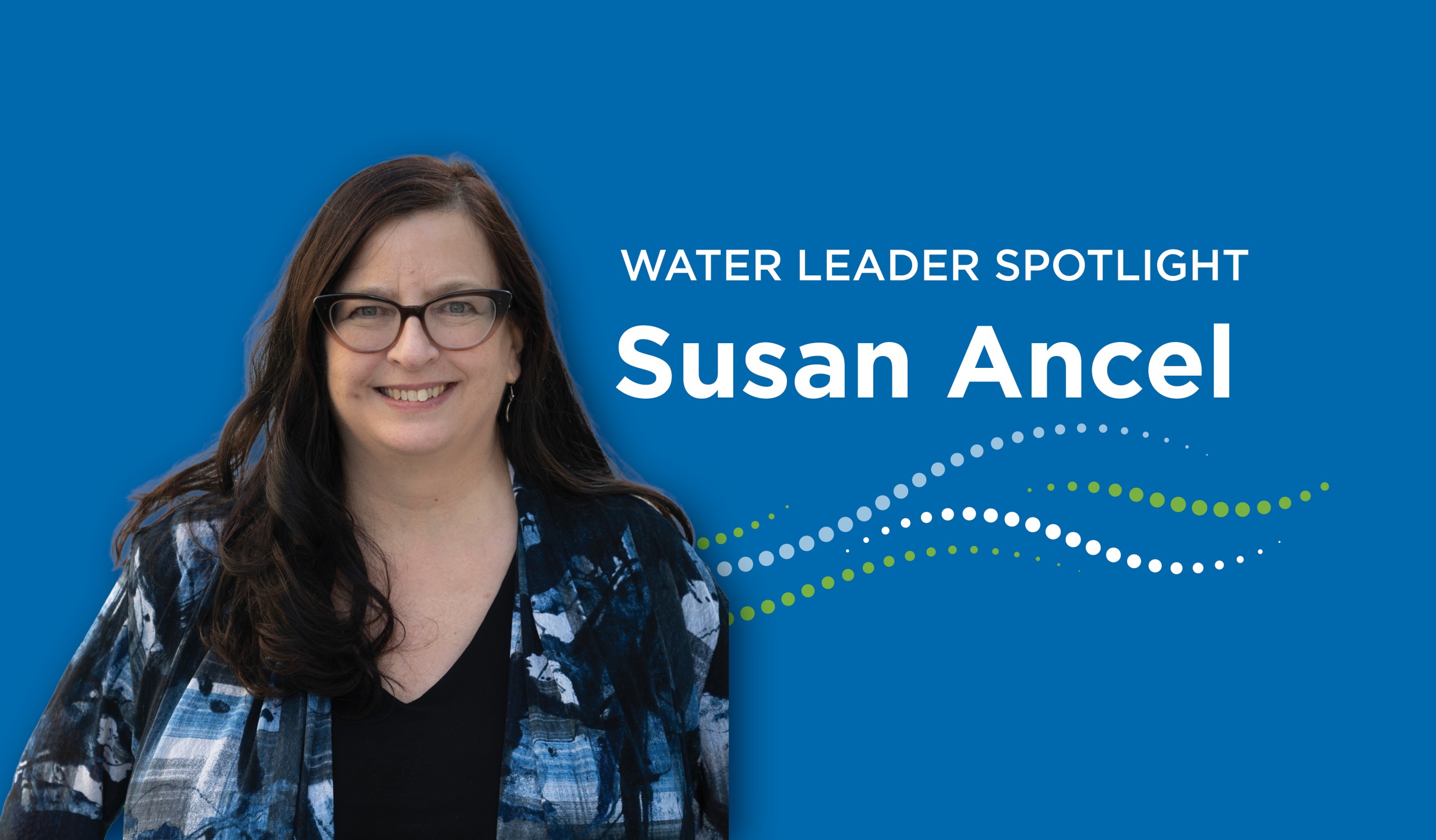
Canadian Water Network’s (CWN) Water Leader Spotlight celebrates municipal water leaders from across the country by sharing their career journeys and perspectives on the evolving water landscape.
In this edition, Municipal Water Program Manager Nancy Goucher speaks with Susan Ancel, senior principal water strategic initiatives at EPCOR. With Susan’s retirement in March 2026, this timely conversation reflects on her path through the water sector, the innovations she helped introduce, and her insights on how utilities can strengthen relationships with the communities they serve.
Her commitment to the sector extends beyond her formal roles: Susan also served as a volunteer member of CWN’s Board of Directors for nearly nine years and contributed her expertise to climate action as a member of the Climate Reality Project Canada board for more than five years.
Long before Susan began designing water systems, she was learning discipline in a different studio, one with a barre, mirrors, and hours of practice. As a youth, Susan trained seriously in ballet, performing in productions and refining resilience that later shaped her engineering career. But her interests were never limited to the arts. She excelled in science and math, ultimately creating a conflict with dance leaders who expected full dedication to the arts. Guidance counsellors, too, encouraged her away from STEM careers, steering her toward “more suitable” artistic fields.
A chance encounter shifted her path. At a gathering with friends, Susan met a third‑year chemical engineering student. It was a brief conversation, but one that had a lasting impact. The student described engineering as a field rich with creativity, problem‑solving, and innovation, exactly what Susan was looking for.
“She told me engineering was actually very creative,” Susan recalls. “You have the formula, the science, but what you choose to design with it, and how you solve problems, requires imagination and understanding people.”
That conversation helped Susan push past the gatekeeping she had encountered. She advocated for her own academic direction and entered engineering, where she quickly discovering that the blend of structure and creativity felt right. “Ballet taught me to understand movement,” she says. “It helped me visualize fluid systems in my mechanical engineering training and anticipate flow. It prepared me for water more than I realized.”
Finding her path in municipal water
Susan began her career at an engineering consulting firm in the HVAC mechanical division, but it wasn’t where she felt most energized. That became even more apparent when the entire division left the company, leaving her as the sole remaining engineer. Unsure what to do with one of their first women engineers, Bob Savage, president and chief operating officer for the consulting firm, helped her transition into the municipal engineering division.
He became an early mentor. “He found me a home to apply my mechanical engineering training in the traditionally civil engineering field based on what I enjoyed and was good at,” she says. “It made all the difference.”
After five years at the consulting firm, Susan saw an opportunity with the City of Edmonton’s Water Branch and joined the team responsible for reviewing and approving subdivision development applications. Three years later, the water branch transitioned into EPCOR, and Susan moved with it. With the support of Allan Davies, then senior vice president for EPCOR Water, she transitioned into a new, unique role leading the long-range planning and transmission operations for the utility — two areas that had traditionally been managed separately.
The combination of public‑sector stability and the dynamic, problem‑solving environment appealed to her immediately. “EPCOR offered the best of both worlds,” she explains. “You could tackle big municipal planning challenges while still having the operational focus of a utility day-to-day operations and meeting customer needs.”
The transition to EPCOR also broadened her exposure beyond Edmonton’s boundaries, giving her the opportunity to support utility planning approaches in other jurisdictions and observe how different utilities grow and evolve over time.
Introducing integrated resource planning (IRP) to water
In 1994, Susan helped bring integrated resource planning into EPCOR’s water business at a time when it was primarily used in the electrical sector and rare in water sector. The shift was more than a tool; it reframed how the water utility prioritized planning decisions by focusing on system reliability during multiple operational scenarios, customer water use behaviour, and watershed management approaches to minimize impacts of the river on water treatment operations.
This change in perspective had tangible results. EPCOR reduced per‑capita water consumption over the last 25 years by almost half and improved system reliability through targeted investments in reliability in the plants and water transmission network. This enabled the utility to defer a major water treatment plant expansion from 1992 to 2006. It fundamentally changed how people use and interact with water in Edmonton.
The early adoption of integrated resource planning, now widely recognized as adaptive planning, positioned EPCOR as a North American leader in long‑horizon, risk‑informed water planning well before the approach became mainstream in the sector.
Expanding IRP thinking to stormwater
Another significant area in which Susan advanced EPCOR’s thinking was in leading the development of the Stormwater Integrated Resource Plan (SIRP) shortly after the City of Edmonton Drainage Branch transitioned to EPCOR in late 2017. Stepping out of her management role as director of water distribution and transmission, she led a small team in adapting the IRP techniques originally developed for the water utility to address emerging challenges of flood mitigation and climate change.
Completed in 2019, the SIRP resulted in the development of a $1.6-billion, 30-year strategy. This was a far more efficient and targeted plan compared to the previous $4.6-billion, 90-year strategy. The new approach significantly accelerated the City of Edmonton’s ability to prepare its stormwater network for climate change impacts while reducing long-term costs. In recognition of this work, Susan received a Clean50 award in 2021.
Most recently, until May of 2025, Susan was part of the leadership team working on EPCOR’s initiative to transition the previously separate water and wastewater/stormwater utilities into a One Water approach. In this role, she helped broaden the use of IRP concepts to strengthen system-wide resilience and worked closely with customers to advance adaptive planning across the full water cycle.
From service provider to community partner
Susan believes the water sector is undergoing a necessary evolution. Utilities are no longer just siloed service providers; they must become community partners, working alongside planners, developers, and residents to support sustainable development and look at water through a One Water lens.
“Water touches everything,” she says. “Public health, land use, affordability, climate resilience. Utilities can help communities navigate these complexities by sharing information early and often.”
This includes leveraging new data capabilities. Real‑time metering and system analytics allow utilities to understand customer behaviour, identify inefficiencies, and support smarter decisions. But Susan cautions that data alone isn’t enough. Transparency, communication, and trust are necessary to help communities move forward in a time of rapid change.
Championing the next generation
Having started her career when women engineers were rare, Susan has long worked to encourage young people, especially girls, to see engineering as a creative, fulfilling path. Through programs like Stepping Stones in the 1990s, she visited junior high classes to talk about engineering and help break down the misconceptions she encountered early in her own career.
She is also deeply committed to the profession’s ethical foundations. As the Chief Warden of Camp 6 in Edmonton, she leads the planning for The Calling of an Engineer ceremonies, where graduating engineers receive their Iron Rings and commit to uphold the profession’s standards.
“It’s about responsibility,” she says. “Engineering decisions affect people’s lives. Passing that message to new graduates matters.”
A practice of lifelong learning
Those who work with Susan know that she has an exceptional memory. She has the ability to retrieve details from years past. She attributes this to two habits: writing things down and setting aside time for regular reflection. Every six weeks, she dedicates four hours to reading, studying, and thinking about long‑term trends. And in her spare time, she compliments the technical knowledge with lessons from the history books and biographies. These stories help her understand societal patterns and decision‑making under uncertainty.
“It keeps me grounded,” she says. “You can’t get caught up only in today’s tasks. You need to keep learning.”
Looking ahead
As Susan prepared for retirement, she reflected on a career grounded in service, innovation, and a commitment to improving outcomes for communities. She helped bring adaptive planning to the water sector, championed full cost accounting of water, advanced conservation, and led one of Canada’s most significant stormwater strategies. She also helped mentor a new generation of engineers who will continue advancing the field.
For Susan, the work has always been about more than infrastructure. “At the end of the day,” she says, “water utilities support the health and resilience of communities. When we think creatively, collaborate broadly, and plan for uncertainty, we can help cities thrive.”
Her career offers a clear message for the sector’s future: engineering is technical, but its purpose is deeply human.