When wildfires threaten our water – Increasing resilience in a changing climate
As wildfires increase in frequency and intensity across Canada, their impact goes far beyond scorched forests and smoky skies. They’re quietly threatening one of our vital resources — clean, safe drinking water.
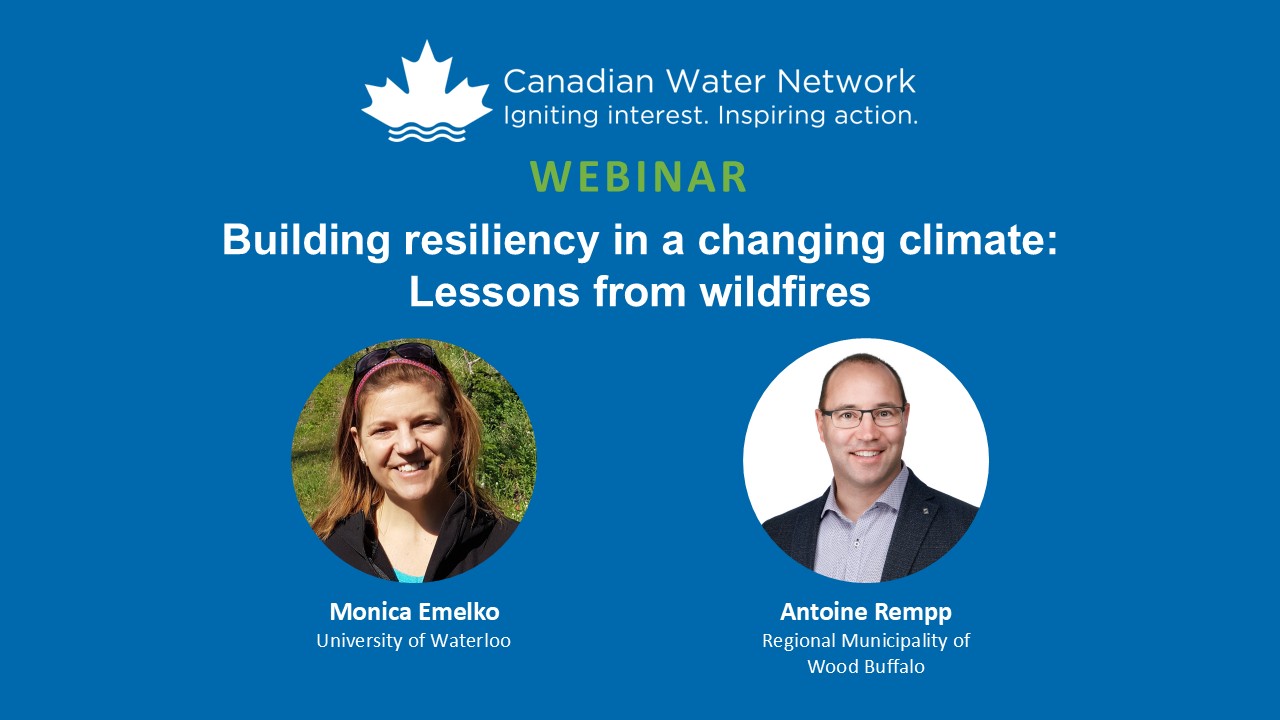
On July 21, 2025, Canadian Water Network (CWN) hosted a webinar to explore how communities can increase resilience to climate shocks, with a focus on lessons learned from wildfire preparedness. The session featured Professor Monica Emelko from the University of Waterloo and Antoine Rempp from the Regional Municipality of Wood Buffalo in Fort McMurray, Alberta.
Professor Emelko opened the session by emphasizing the far-reaching impacts of wildfires. “Not only do wildfires impact water quality and water treatability,” she explained, “but they can also have implications for the ecosystem and the watershed. They can affect the hydrology of the system as well as water availability.” Her presentation introduced a practical framework for climate shock preparedness that emphasizes the importance of strategic, long-term monitoring and of understanding your watershed in the face of wildfires, floods and other disturbances. Professor Emelko noted that “you can’t rely on the past to predict the future, so if you’re not monitoring, you have little ability to gauge if there’s a change in your system.” Key takeaways from her framework include:
- Knowing your source, since disturbance impacts are best identified with pre-disturbance data.
- Ensuring that data collection spans both pre- and post-disturbance periods to reflect hydroclimatic variability.
- Ramping up monitoring after events like wildfires.
- Identifying appropriate reference watersheds when baseline data are unavailable.
Antoine Rempp shared Fort McMurray’s experience following the 2016 Horse River Wildfire. “Nine years later, we are still experiencing impacts at the water treatment plant,” he said. “The impacts might continue for years or potentially decades.” Despite only a small portion of the Athabasca watershed being burned, the municipality has faced persistent challenges, including increased organic matter and recurring algal blooms. Rempp described how the team tested various treatment options and found ozone to be the most promising, though costly. He also highlighted the importance of adaptive management, sharing that “the more we collaborate and share knowledge, the better equipped we are to adapt and respond to the evolving challenges climate change brings to our water systems.”
The webinar underscored several key themes: the need to focus on treatability rather than just treatment, the value of long-term and event-based monitoring, and the importance of collaborative, site-specific solutions. Both speakers emphasized that proactive planning and flexible infrastructure are essential to navigating the growing complexity of climate-driven water challenges.
As climate shocks become more frequent, CWN’s webinar served as a timely reminder that resilience is not just about recovery—it’s about readiness, foresight, and working together to protect our water future.