
Financial sustainability starts with better infrastructure decisions
October 5, 2026
CWN’s quarterly newsletter with the latest news, insights, and thought leadership.
From forecasting the future to preparing for it
Traditional infrastructure planning generally relies on forecasts of future conditions—population and development, demand, regulatory requirements and other assumptions—and identifies the infrastructure required to meet that expected future.
The challenge is that many of those assumptions are becoming less predictable. Population growth may occur faster, slower or in different locations than anticipated. Climate impacts are changing. Construction costs and funding fluctuate. Regulations and technology evolve. Consequently, a large infrastructure investment made today may therefore prove too large, too small, poorly timed or insufficient as conditions change over time.
AWIP takes a different approach (see Figure 1). Rather than asking utilities to predict one future correctly, it helps them prepare for several plausible futures and develop infrastructure pathways that can change as conditions evolve. The objective of AWIP is straightforward: the right infrastructure, at the right scale, at the right time, while keeping viable options open for the future.
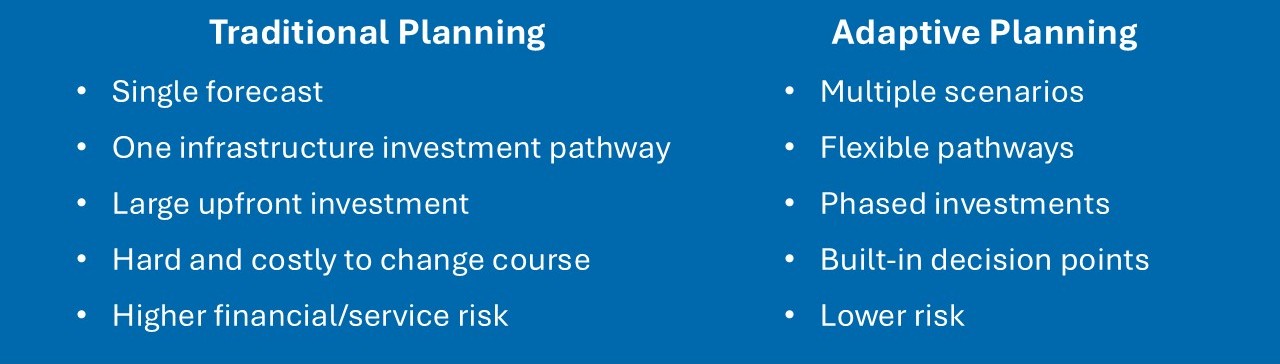
Figure 1: Traditional versus adaptive planning. Source: CWN, AWIP Primer (2025).
Traditional planning may rely on a single forecast, one infrastructure pathway and significant upfront investment. Adaptive planning instead uses multiple scenarios, flexible pathways, phased investments and planned decision points.
Optionality and deferral are financial tools
One of the most important financial concepts within AWIP is that not making the entire investment today can itself have value.
Where infrastructure can be phased, modularized or expanded over time, utilities may be able to defer portions of capital expenditure until conditions demonstrate that additional capacity is actually required, as illustrated in Figure 2.
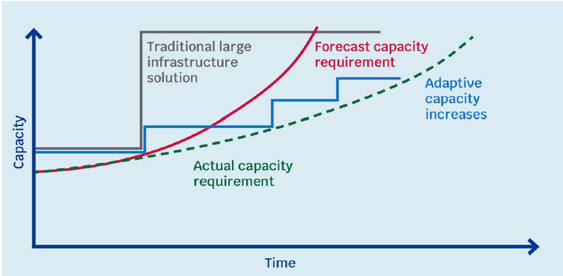
Figure 2: Traditional, large infrastructure solution versus an adaptive approach to infrastructure investment. Source: OFWAT, PR24 and Beyond: Final guidance on long-term delivery strategies (2022).
An adaptive approach to infrastructure planning does not mean delaying necessary investment, rather it means distinguishing between infrastructure needed under almost every plausible future and investments that may only be required if particular conditions emerge. Monitoring and predetermined triggers can then signal when another investment, expansion or alternative pathway should be considered.
A case in point
Metro Vancouver’s Iona Island Wastewater Treatment Plant provides a Canadian example. An original full-build concept was estimated at approximately $9.9 billion. Metro Vancouver subsequently moved toward an adaptive pathway incorporating membrane bioreactor technology, and monitoring and triggers to signal when an adaptive response is required. The approach reduces near-term financial exposure while preserving flexibility as uncertainties around growth, funding, regulation and technology evolve.
The financial principle is important: flexibility has value. Avoiding premature investment, preserving options and reducing the risk of stranded or under-utilised assets can be as important to long-term financial sustainability as finding a less expensive source of capital.
Expanding infrastructure choices can expand financial choices
AWIP also broadens the question from “What project should we build?” to “What combination of infrastructure can provide the required service and resilience at the best lifecycle value?” This can include conventional grey infrastructure alongside green infrastructure, natural assets, distributed or modular systems, water reuse and recycling, demand management and digital technologies (See Figure 3).
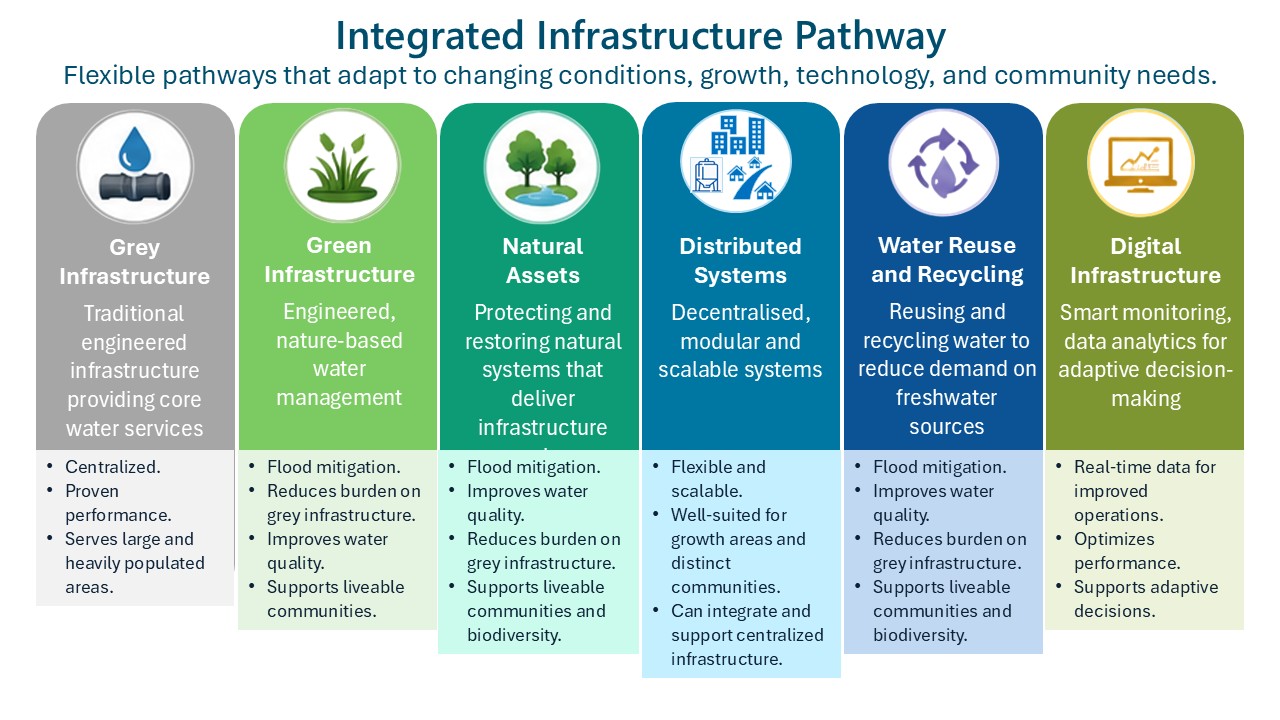
Figure 3: Integrated infrastructure pathway. Flexible pathways that adapt to changing conditions, reduce risk to critical assets and communities, and increase resiliency. Source: CWN (2026).
Evaluating integrated infrastructure solutions matters financially because alternatives that appear more expensive or unconventional when viewed only through their initial capital cost can look very different when avoided costs, lifecycle costs and broader system benefits are included.
Lancaster, Pennsylvania provides an example of the value of an adaptive planning approach that considers integrated delivery. Its analysis of green infrastructure estimated approximately US$120 million in avoided grey infrastructure capital costs and US$661,000 annually in avoided pumping and treatment costs, in addition to broader environmental, community and economic development benefits.
The lesson is not that green infrastructure will always be the least-cost solution. It is that the business case needs to value what an investment avoids as well as what it costs.
Looking beyond individual projects and municipal boundaries
Some infrastructure solutions may be too small or fragmented to deliver efficiently on their own. Others may make more sense at a regional, watershed or intermunicipal scale.
Project aggregation and intermunicipal collaboration therefore also belong in the financial sustainability discussion. Municipalities can share infrastructure and expertise, jointly procure services, co-ordinate investments or aggregate smaller projects into larger programs or portfolios. These approaches can distribute costs and capabilities, create economies of scale, increase resiliency and, in some circumstances, improve access to financing.
Abbotsford and Mission, British Columbia, for example, share regional water and wastewater infrastructure while retaining their individual local systems. In Italy, the Viveracqua Hydrobond model aggregates investment programs from multiple publicly owned water utilities into structured bond issuances, creating financing scale while maintaining public ownership.
These examples raise an important question for Canadian utilities may want to explore: can better financial and infrastructure outcomes be achieved by planning and investing collectively rather than project by project and municipality by municipality?
Connecting infrastructure planning and financial planning
Financial sustainability is ultimately about more than paying for infrastructure. It is about ensuring communities can continue to afford the infrastructure and services they need over the long term.
AWIP does not replace master planning, asset management, capital planning or financial planning. It can strengthen them by explicitly incorporating uncertainty, risk, timing, and flexibility into infrastructure investment decisions.
In addition to asking “How do we finance this project?”, utilities using AWIP ask more questions to explore a range of possible solutions:
- Do we need the entire investment now?
- Could it be phased or scaled as conditions change?
- Are there more flexible ways of providing the same service?
- What costs could the investment avoid or defer elsewhere?
- Could green, natural, distributed, or digital infrastructure complement conventional assets?
- Could projects be aggregated or delivered collaboratively?
- Once the preferred pathway is clear, what combination of revenue, funding, and financing is best suited to deliver it?
The focus of AWIP and integrated infrastructure pathways is to fit financing to infrastructure strategy, rather than having the infrastructure strategy shaped by available financing.
Building financially sustainable water infrastructure
Building on international expertise and experience and the knowledge of Canadian utility leaders and practitioners, CWN is developing AWIP as a practical approach for municipal water utilities. The work is increasingly connecting infrastructure planning with finance, asset management, risk and implementation.
CWN is also exploring how global and Canadian experience with alternative revenue and financing approaches, avoided-cost valuation, infrastructure aggregation ,and intermunicipal collaboration could complement AWIP. The goal is not to promote a particular financing model or replace public ownership and delivery; it is to give utilities a wider range of practical tools for developing infrastructure portfolios that are technically sound, resilient, and financially sustainable.
Canada’s water infrastructure challenge will not be solved simply by spending more, nor by finding new ways to finance the same infrastructure choices. It will also require making those choices differently, and considering a wider range of infrastructure options, investing incrementally where appropriate, capturing avoided costs and resilience value, collaborating where scale creates advantages, and preserving the ability to adapt as conditions change.
Financial sustainability starts before the financing decision. It starts with deciding what to build, when to build it and how much flexibility to preserve for the future.