
CWN presents lifetime achievement award to Carl Yates
June 16, 2025
CWN’s quarterly newsletter with the latest news, insights, and thought leadership.
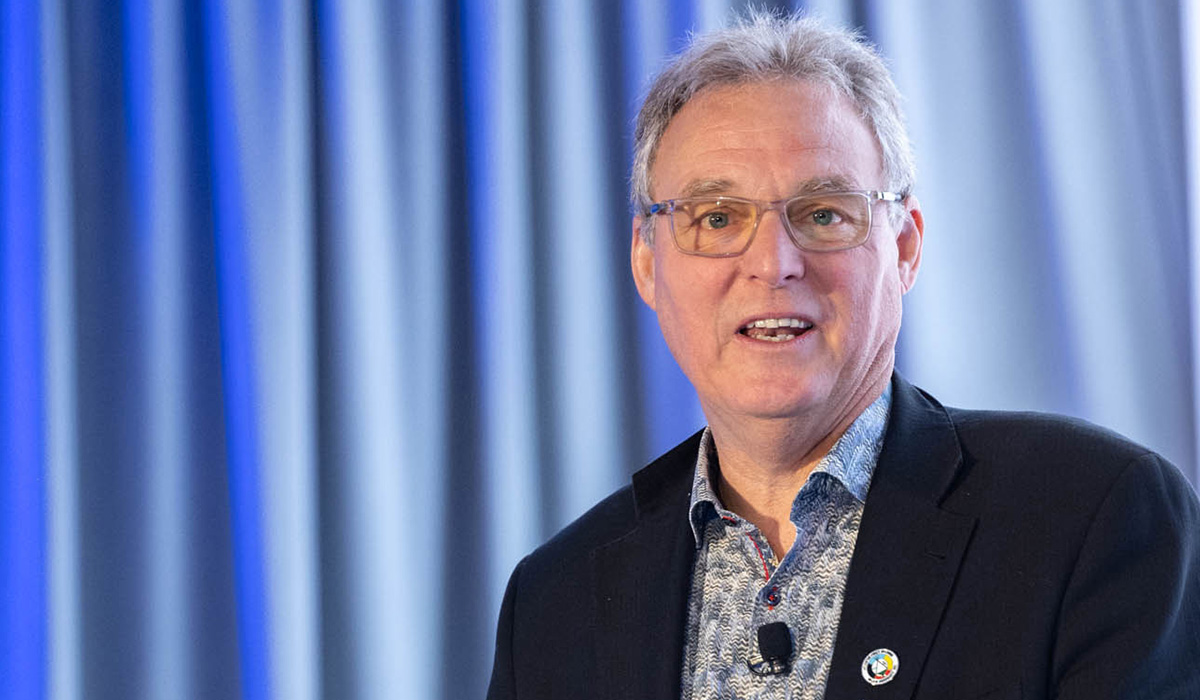
CWN’s inaugural Lifetime Achievement Award was presented to Carl Yates by CEO Nicola Crawhall at Blue Cities 2025.
Nicola’s remarks:
We have now come to our third and final award of the day, which is our lifetime achievement award. This award recognizes a retiring member of the Canadian water sector who has demonstrated incredible leadership ingenuity and who leaves a lasting impact. Without further ado, I am going to open the envelope… the 2025 Lifetime Achievement Award goes to Carl Yates.
Carl is an outstanding water leader; many of you know him through his years associated with CWN. Over a career spanning 40 years, Carl has been a pioneer in water services and governance. Carl served as general manager of Halifax Water for 25 years, where he led the utility through two mergers. Halifax became a regional water utility in 1996, and in 2008, Carl oversaw the merger of water, wastewater and stormwater services, making Halifax Water the first regulated water, wastewater and stormwater utility in Canada.
Under Carl’s leadership, Halifax Water was the first utility in North America to adopt IWA’s best practice in water loss control and captured approximately 40 million liters in leakage per day by 2007. For this action, the utility received the Federation of Canadian Municipalities’ Sustainable Community Award in 2005. Halifax Water was also the first utility to employ flow modulated pressure management in a dual feed DMA and won the 2014 CSCE Award for Excellence in Engineering Innovation.
Carl was awarded the Engineers Nova Scotia Sexton gold medal in 2019 for exceptional achievements in engineering practice and contributions to society. Also in 2019, Halifax Water won the Nova Scotia Lieutenant Governor Award for Engineering Excellence for daylighting the Sawmill River in Dartmouth. Carl also received the AWWA Abel Wolman Award of excellence in 2021.
So that’s not a bad career right there, Carl. But there was a groundbreaking second act, as well. As interim CEO of the Atlantic First Nations Water Authority, Carl guided the establishment and first three years of operation of the first, and so far, only, Indigenous water utility serving the communities and traditional territories of the Mi’kmaq and Wolastoqiyik. In 2022, Carl received a Federal Deputy Minister’s recognition award for this work.
Carl, I’m told that your signature line on presentations is, “Do not follow where the path may lead. Go instead where there is no path and blaze a trail.” Your career achievements demonstrate that you have lived up to this motto.
Carl is also an outstanding volunteer who provided extensive support to the water sector at CWN. He’s been on the Board for 12 years and the last six as Board Chair. Not only did he help guide CWN in its transition from a National Centre of Research Excellence to its current state, he also saw CWN through a leadership transition when longtime CEO Bernadette Conant stepped down and I took over. Throughout, Carl has been a stalwart support of CWN. Carl recently announced that he’s stepping down from the Board in June.
On behalf of myself and the board, I want to take this moment to thank Carl for his unwavering support, perpetual optimism, and encouragement for the whole team and for me, in particular. Carl, on behalf of CWN, it is an honor and a privilege to present to you CWN’s first Lifetime Achievement Award, which will be affectionately known as the “Yatesi.”
Remarks by Carl Yates:
I guess it’s my turn and I’d better say a few words too! Well, certainly thank you to CWN and my peers for recognizing my career. I appreciate this very much, but I’ve got to come forth and say that this is recognition that I share with you — my water utility colleagues and friends — because you’re the ones that have supported me through my career. And when it comes right down to it, what is the achievement? I can say that the achievement that I’ve obtained is relationship. And I’ve had wonderful relationships. I will continue to foster these relationships because this has the most meaning in life; it’s why we’re here. We are herd animals, so we like to be in each other’s company. I’m so pleased that I’ve been in your company.
So, as often happens, I was challenged by Nicola. She told me — yes — that I was going to get this award and that I might say a few words about what achievements stood out. Joining the water profession in 1988 is one. I came from a consulting background initially, and I was very privileged to establish my career with Halifax Water. There was a fine gentleman there that mentored me and positioned me for next steps. His name is Bill Gates. You think it might be Bill Gates, the founder of Microsoft. No, the original Bill Gates is from the Annapolis Valley of Nova Scotia.
Bill is long retired from Halifax Water after serving as general manager. One of the directives he gave to me is to make sure that you know how to run your system better than any consultant that works for you. He expected me to have the knowledge of how this thing works and encouraged me to do as much design work as possible. I was in the engineering department, and he said, “You’re going to be designing some of these pump stations and distribution mains.” So, I rolled up my sleeves. But he was always close by to check on those designs. It was Bill that fostered my skills and abilities to a large extent.
An opportunity came when I was 34 years old when Bill decided to retire at the age of 60 and go on to be a consultant. I was chief engineer at that time and realized this might be the only opportunity to become the CEO of Halifax Water. So, I threw my hat in the ring and something happened… I caught the train. And then when the competition was over, I said, “Oh what have I done? If you were kept awake at night being chief engineer, it’s not going to get any better from here.” But certainly, it’s been a great ride.
It’s the relationships that have meant so much. There are always a few stories I have to tell about this, because people ask, what does that mean? Can you really describe that? One of the best things that ever happened to me was when I became general manager, I got a broader perspective of what’s happening in the utility.
I realized that there were people in my organization, in operations particularly, that had literacy problems (the ability to read, write and do math). I could see where the future was going, with standards coming in, operator certification and other challenges. And I said, “We’ve got to do something about this.”
We rolled up our sleeves and brought an adult literacy program to Halifax Water. I remember that we had 22 people enrolled and 20 graduated with their GED. It really opened doors. Once people saw that they could do these things, it was amazing to watch them shine. Many of these individuals went on to get more education and certification. It was wonderful to see two participants, a father and son, take the GED together. It really, really meant a lot to me to see them rise to that challenge. I think it was a foundation for what was to come — the change that we experienced afterwards. You heard earlier about the regional utility formation in ‘96 and shift to a One Water utility in 2008. These foundations were built on trust and relationship with the people I worked with.
Some of the other fun things… I am an engineer, and yes, I do like to dabble and play in the fields of our Creator. It’s always fun when you get the opportunity to jump in a trench. I still enjoy jumping in a trench! That’s what got me going a lot of times — the ability to put my hands on tools and talk with the staff in the trench.
After we merged as a regional utility in ‘96, we had to build a brand-new treatment plant in Dartmouth. This system had extremely aggravated levels of leakage, and that was quite challenging for us to look at. At first when we started designing the plant, a lot of people wanted to make it bigger. In terms of size, it was not a huge plant, but a decent size. It was designed for 16 million gallons/day, on average and 20 million gallons/day for peak. At that time, the system was receiving about 14 million gallons/day. People were saying, “You really should make this bigger because there’s not much room before we hit capacity.” But I’d already talked to a lot of the distribution staff and folks that worked there. They all came clean and said, “Look, about a third of this water doesn’t reach the customer right now.” I said, “Aha! Well, here’s what we’re going to do instead. We’re going to find alternative capacity. It’s not upstream, it’s downstream.” That’s when we went on our search and as Nicola mentioned, became the first utility in North America to adopt the IWA methodology.
We went on a search for the best practice, and we found it. We flew across the pond and talked to our European friends, particularly our friends in the UK. We saw what they were doing, brought it back to Halifax Water and implemented to great fanfare. As part of our approach, I banned the term “unaccounted for water” in my utility. You weren’t allowed to speak of it because we wanted to be accountable.
So that’s one of my favorite projects that I’ve had the privilege to work on. To work with the staff to make a difference and recapture 40 million litres per day so that we had lots of capacity. There were about 14 million gallons/day going into the system in 1998/99. Anyone want to take a guess of what’s going into the system now? On an average day 10 million gallons per day; they’ve still got six to play with before they reach capacity of that plant. That’s what you can do if you look after what you have. It’s really important to realize that there’s good value in maintaining what you have.
The water loss control program was very difficult because you have to involve a lot of people to be successful and break down the silos. You’ve got to get people collaborating across departments, collectively making a difference. Once we established this through committees, I didn’t have to do much. I just had to give them resources and get out of their way — that’s often what leadership is. Now that it’s been embedded, there’s no longer a need for committees because it’s become a culture of finding leakage. It’s a badge of honor that continues today.
There are other highlights, of course, that I know I’m going to miss. But it’s ironic to a certain extent, that at the very tail end of my career I got to do the most rewarding and difficult thing I’ve ever done. I was given the privilege, to lead the formation of the Atlantic First Nations Water Authority.
While I was general manager at Halifax Water, I got involved in supporting First Nations. It was of great interest to me to try to give back and support our Indigenous friends. I got involved in a project with Dr. Graham Gagnon from Dalhousie University to look at the governance aspects and try to find the right model that would work.
Then I tried to retire in 2019. I suppose I wasn’t very good at it, because it wasn’t even a year later that the Chiefs tapped me on the shoulder and said, “We know you’ve retired, but would you like to take this on? We think you’ve got the right skillset.” So, I said okay, but there’s one key thing — I’ll be the interim CEO. Let’s make this understood; I’d love to see somebody from a First Nations lead this utility. I had this printed on my business card: Interim CEO.
What great relationships I had working with AFNWA. That’s how you are going to be successful working with Indigenous communities. Here’s some good advice I’ll give you today: establish relationship first. Reach out, meet people where they are, journey with them — then great outcomes are possible. I still think back and ask, how did we do this? We built the utility during the pandemic, so we had restrictions for travel to meet with everybody, but we had a very definitive approach to how this was going to happen.
We took a top-down and a bottoms-up approach to relationship. Obviously, we needed to work closely with the Chiefs and Councils and senior leaders, but we also worked very closely with the Operators. Two years ahead of when we were supposed to take over responsibilities, we started holding Operator workshops. Every three months we’d have a workshop, bring Operators up to speed, talk to them about where they were with their skills and abilities, and spend money ahead of time to help them get training and their certification. By the time we actually got to hiring them on the day of transfer, many of them had already received their certification with our support. So, they really bought into what we were trying to accomplish.
It’s all about the relationship. I know that my achievements are based on relationship, especially to most of you in this room. You’ve been a great part of my journey. I thank you for journeying with me and ask you to continue the journey — and to mentor younger professionals, to bring them with you, and to teach and be taught. There’s no shortage of learning, no matter what your age.
Thank you very much for the recognition.