
Water leader spotlight — Bu Lam, City of Kitchener
October 5, 2026
CWN’s quarterly newsletter with the latest news, insights, and thought leadership.
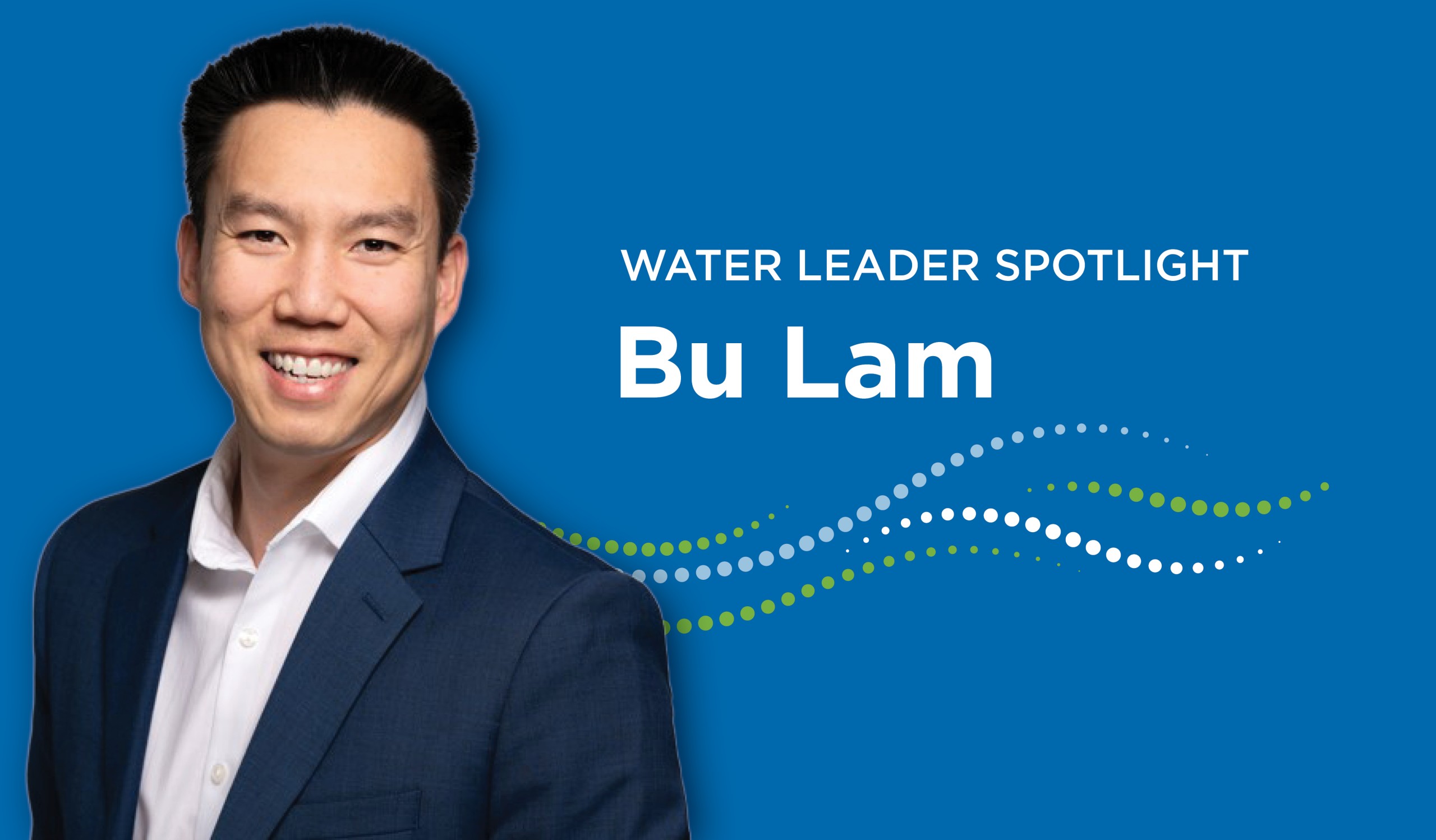
Canadian Water Network’s (CWN) Water Leader Spotlight celebrates municipal water leaders from across the country by sharing their career journeys and perspectives on the evolving water landscape. In this edition, Senior Program Advisor Katina Tam speaks with Bu Lam. He is the director of sanitary and stormwater utilities for the City of Kitchener. Read on to learn about his journey in the water industry.
Can you describe what led you to choose a career in municipal water? What has your career path looked like since you joined the industry?
I fell into the municipal water world accidentally. I have a PhD in Environmental Chemistry from the University of Toronto. While water research was my focus, pursuing a career in municipal water didn’t cross my mind at the time.
I began my journey in municipal water when my wife and I travelled to Nunavut for her job. At the time, I was looking for work in water research; however, there weren’t many such opportunities in Nunavut. Instead, I found a job as manager of infrastructure programs with the Government of Nunavut, structuring a research program in response to federal Wastewater Systems Effluent Regulations (WSER) for the Far North. My portfolio covered not only water and wastewater, but also municipal assets. In time, I became the director of community infrastructure, where I oversaw municipal infrastructure and capital planning for 24 of Nunavut’s 25 municipalities, a portfolio that included municipal buildings, community centres, fire stations, water and wastewater facilities, and recreational facilities.
Despite the broader portfolio of municipal infrastructure, water was always a career passion. When I left Nunavut, I moved back to Southern Ontario and was fortunate enough to find my way back into the municipal water world through my role as manager, and subsequently director, of the Canadian Municipal Water Consortium at Canadian Water Network. In this role, I connected with and learned from municipal utility leaders from across Canada, which further fuelled my passion for municipal water. From there, I returned to the public sector and joined the City of Kitchener as director of sanitary and stormwater utilities.
I often joke that I don’t use much of my PhD background in my day-to-day work. But the reality is, graduate studies taught me how to think critically, formulate questions, and approach problems from multiple angles. We regularly tackle complex challenges in the municipal utility sector that don’t have a single solution, and the skills I developed through research help me navigate those challenges.
What do you enjoy most about your work?
I really enjoy the problem-solving aspect of the job and coming up with creative solutions while collaborating with many different people. Bringing ideas together, sifting through them, and coming up with strong options is exciting to me.
With problem-solving comes the opportunity to explore innovation by looking at new technologies, new ways of doing things, and new ideas. When I reflect on innovation and problem-solving, it’s the people who make it all happen. I find passionate people infectious, and the water industry attracts truly great people who want to coalesce around a common goal of protecting public and environmental health.
There are significant challenges facing us today, particularly when it comes to climate change, and I see people in the water industry leading the way on this by exploring solutions and thinking outside the box. This energy around innovation and collaboration makes my job very enjoyable.
Who has been most influential in your career, and why?
One of my first bosses, Roy Green, had a significant influence on my career. Roy Green served as a director, then assistant deputy minister, and eventually deputy minister with the Government of Nunavut. Throughout that time, he provided valuable guidance.
Early in my career, I didn’t have a strong sense of the broader picture. Roy was very good at bringing that big-picture perspective to my thinking and helped shape the way I approach problems by considering all the systems in mind. This way of thinking was drastically different from my research background, where I was trying to control all the variables. In the real world, you can’t control all the variables, so you have to account for them when coming up with solutions. That is a very valuable lesson.
Another great mentor is Bernadette Conant, former CEO of Canadian Water Network. She was always very insightful and approached problems in creative ways. One of her sayings about consensus-building still resonates with me today: “It doesn’t matter how right you are if no one listens.” Even if you come up with a brilliant solution that checks all the boxes, it won’t matter if you don’t have buy-in and the political will isn’t there. How we approach a problem is just as important as how we solve it.
I draw a great deal of inspiration from co-op students. They bring fresh ideas, passion, and great energy. At the same time, I continue to learn from colleagues who have been with the organization for over twenty years, as they know their roles so well. Not only can they come up with solutions, but they can also explain the context behind them, which is a critical lesson when we are telling stories of our work to the public.
What has been the proudest moment in your career in municipal water management?
Early in my career with the Government of Nunavut, I was tasked with developing a response to the federal Wastewater Systems Effluent Regulations (WSER), which had a goal of harmonizing one set of wastewater regulations for all jurisdictions in Canada. However, this harmonized approach was going to have major implications for the Far North, which has significantly different conditions and challenges from the rest of southern Canada. Through substantial coordination with other Far North jurisdictions, an extensive research program, and meetings with government officials, we were able to advocate for the Far North being treated differently than the rest of southern Canada. I’m proud of this moment because the groundwork that was laid to establish the uniqueness of Far North jurisdictions still resonates in the WSER regulation today. This work taught me a great deal about how to approach consensus-building.
What is an emerging trend in the water sector you think water leaders should look out for?
We are already seeing AI as a major disruptor in all sectors, and this is no different for the water sector. AI is potentially a very powerful tool, but we have to be cognizant of how we apply it in our systems. We also need to consider how we utilize and process data, which segues into cybersecurity.
We know there have been a lot more cyberattacks in recent years, and those attacks are becoming more focused on water utilities. Given the critical nature of the services we provide, it’s important to ensure our systems are secure so that we can continue delivering reliable and sustainable services to the public.
One final trend that I have noticed is the shifting workforce demographic and evolving skill sets. We are seeing many more long-term workers begin to retire while bringing in a new generation of future industry leaders. What does this shifting workforce look like?
I have read that 64 percent of the jobs Generation Alpha will pursue have yet to be created. Utilities need to be prepared to adapt to this shift.
With municipal budget planning on the horizon, what key themes do you anticipate utilities will bring forward?
I think there is going to be a big focus on affordability, with councils across the country being asked to keep tax rates as low as possible. When tax rates are lowered, water and wastewater users fees typically follow suit. This is a challenge for utilities, as we still face investment needs to maintain our infrastructure. So the question becomes “how much can you defer and how much should you defer? What other solutions exist?”
Issues like cybersecurity and climate change are difficult to predict. These are challenges that we have to manage by understanding and managing those risks. As utilities, we need to ask ourselves: “What additional capital and dollars do we need to run these programs and manage risks?”
Additionally, some utilities, particularly those in Southern Ontario, are reviewing governance models and how they may impact utilities. We need to start considering what the future governance of our utilities will look like and how the budgets that we are structuring today may affect that future.
What is something about you that people might be surprised to learn about?
I’m an avid traveller. As I mentioned earlier, I lived in the Canadian Arctic for over six years. To date, I have visited 25 different countries and am constantly looking for opportunities to travel to new places around the world. Along the same vein, I am a self-described foodie and love to explore the local cuisine in all the countries I travel to.
With younger kids, we’ve done a lot of domestic travel and lots of camping trips, as travelling internationally has become a bit trickier. That said, I’ve managed to travel with my family to Greenland, Greece, the U.S., and Mexico. Looking ahead, we’re planning a trip to Vietnam so that my children can experience a part of their heritage.