
A look back at Blue Cities 2026
June 24, 2026
CWN’s quarterly newsletter with the latest news, insights, and thought leadership.
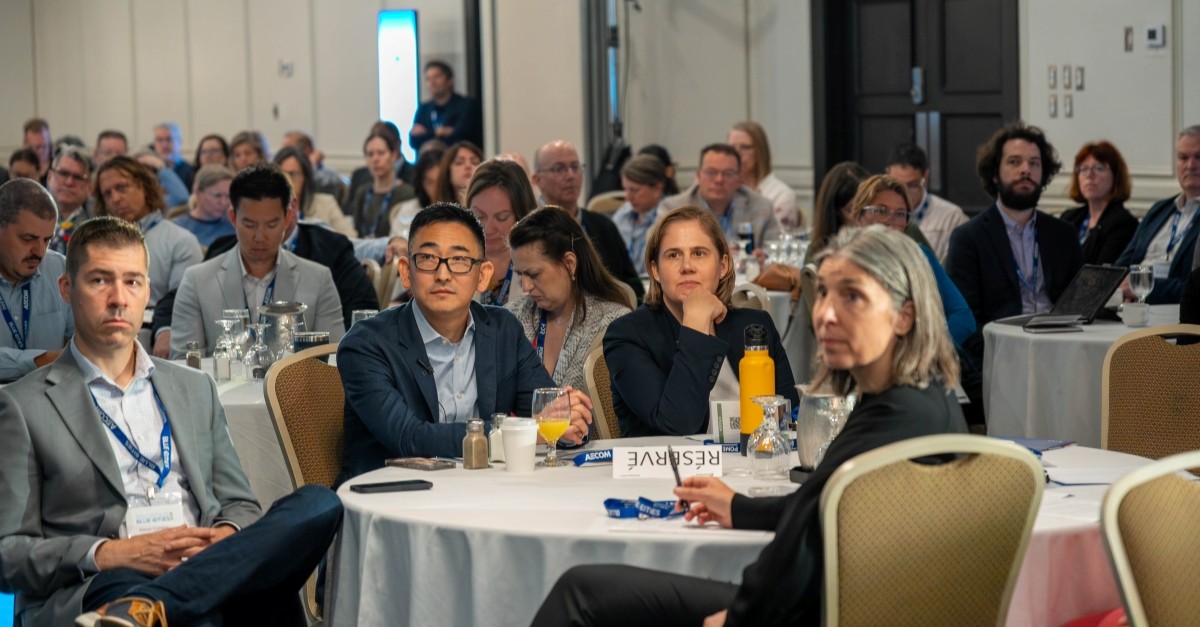
Once again, Blue Cities proved to be THE event for senior decision-makers in Canada’s water sector to network, strengthen relationships, and share their insights and solutions. From June 9–10, Blue Cities 2026 explored the theme Water Security: Strategies for Fiscal and Infrastructure Resilience at the Chateau Cartier Hotel and Resort in Gatineau. The conference drew more than 200 participants — 75 percent of whom were senior decision-makers (such as CEOs, executive directors, partners, and general managers), along with another 23 percent in management roles.
The event opened with a water ceremony, reflecting CWN’s commitment to engaging with Indigenous peoples. Irene Compton, co-founder of Minwaashin Lodge, led the ceremony and set a meaningful tone for the conference.
From there, we heard from Peter Weltman, vice chair of the Canadian Infrastructure Council, who shared insights on Canada’s first National Infrastructure Assessment that was released in November 2025. He highlighted not only where we stand today, but also the critical information gaps we still need to address. These gaps matter — especially when it comes to prioritizing investments and ensuring resilient, sustainable systems for future generations.
We also heard from Mark Fisher, president of the Canada Water Agency. He spoke about how even though Canada has long been seen as a water-rich nation, abundance does not equal water security. This is why working together to develop lasting solutions to our most pressing water-related vulnerabilities is in our national interest.
Throughout the conference, sessions dove into timely topics — from private financing for public infrastructure to water reuse, housing growth under uncertainty, and unlocking the hidden value of wastewater. Together, these conversations point to several key takeaways:
- The sector’s challenge in delivering infrastructure can no longer be measured in terms of the funding gap — it is also about the capacity to deliver. Across multiple sessions, the message was that aging assets, housing pressures, climate demands, and industrial growth are all increasing the scale of investment required. But the bigger constraint is whether utilities and governments have the data, governance, workforce, coordination, and delivery models needed to turn plans into projects.
- Better decisions depend on better integration of data, planning, and institutions. A recurring theme was that stronger outcomes come from connecting infrastructure planning with land use, finance, regulation, operations, and long-term risk. Whether the topic was governance, adaptive planning, housing, or capital programs, the common lesson was that siloed decision-making is no longer enough. Collaboration is essential.
- Resilience must become a practical operating principle, not just a long-term aspiration. Sessions on climate adaptation, buried infrastructure, cybersecurity, and wastewater value all pointed to the same conclusion: future-ready systems are built through practical, staged, and risk-informed action today. That means investing in state of good repair, planning adaptively, building redundancy and preparedness, and finding value in existing systems — not waiting for perfect certainty.
- Water abundance does not mean water security. Canada needs a nationally aligned, regionally tailored, and locally delivered water security strategy that treats water as a cross-cutting issue tied to food, climate, infrastructure, economic and environmental resilience — not as a siloed environmental file. Our challenges moving forward will be inclusive governance, collaborative and adaptive long-term planning, aligning data/monitoring, and municipal leadership as the core enablers. Most Canadians will feel water security at their kitchen faucet.
- Water reuse may become more accepted, and needed, in the future. Canada has been slow to adopt water reuse, given the abundance of freshwater. However, it could be used as a strategic tool to extend capacity and supply and build resilience. Progress will depend on building policy frameworks, public trust, and long-term partnerships. Our challenge moving forward will be to emphasize supply diversification, match reuse to end use, address governance gaps, and act early rather than wait for emergency conditions.
- The funding gap for water infrastructure. Mixing private financing with public funding can be seen as part of a financial strategy for utilities to narrow the infrastructure funding gap, but only if it is structured around affordability, public accountability, and generational equity. The challenge moving forward will be to design collaborative financing and delivery models that appropriately share risk.
The conference concluded with an awards ceremony that celebrated three individuals for their leadership in the Canadian water sector. Emily Zegers from Toronto Water received the Rising Wave Award. Elvis Oliveria from the Region of Peel received the Blue Impact Award. Susan Ancel from EPCOR received the Lifetime Achievement Award. Congratulations to our award recipients! More information about the awards and the recipients is available here.
Looking ahead, the next Blue Cities conference takes place in May 2027. To ensure you receive updates, subscribe to our newsletter.