
Water leader spotlight: Elvis Oliveira — Region of Peel
June 24, 2026
CWN’s quarterly newsletter with the latest news, insights, and thought leadership.
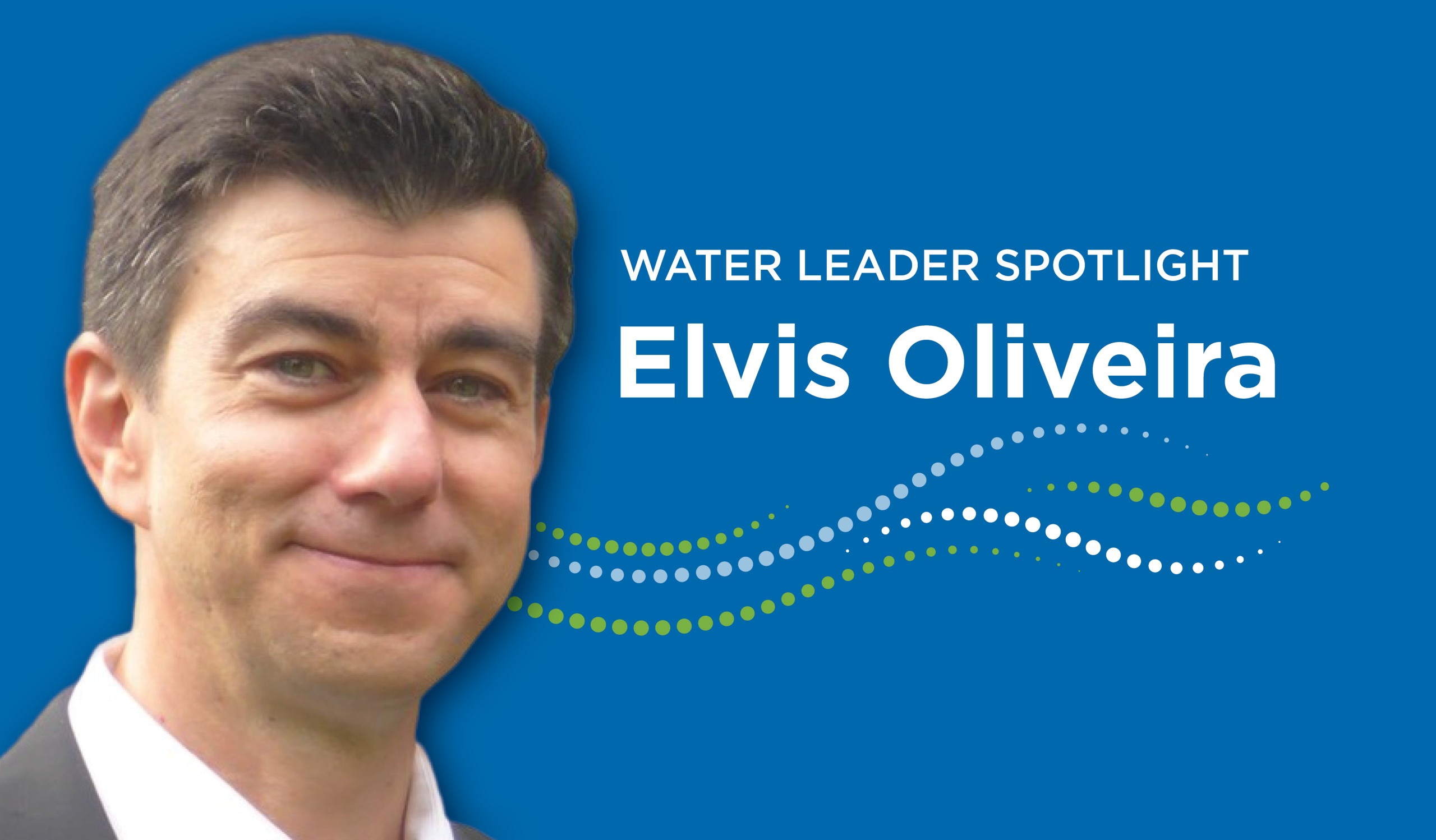
Canadian Water Network’s (CWN) water leader spotlight celebrates municipal water leaders from across the country by sharing their career journeys and perspectives on the evolving water landscape. In this edition, Municipal Water Consortium Manager Nancy Goucher speaks with Elvis Oliveira. He is the senior director of water and wastewater infrastructure planning, partnerships, and compliance for the Region of Peel. At Blue Cities 2026, he received the Blue Impact Award. The award is presented to an individual who represents excellence in utility leadership.
Can you describe what led you to choose a career in municipal water? What has your career path looked like?
I discovered the world of municipal water as a summer student in the bacteriological laboratory at the Lakeview Water Treatment Plant (now the Arthur P. Kennedy Water Treatment Plant) in Peel. During breaks, I would wander through the plant, asking questions and learning from the people who kept it running. It didn’t take long to realize there was something both fascinating and meaningful about the work.
After graduating, I was offered a six-month contract as a water operator. My original plan was simple: save some money and return to school to complete a master’s degree. Instead, that short-term contract turned into a permanent role, and ultimately, the start of a career I hadn’t planned.
Looking back, my career has been less about following a defined path and more about staying open to opportunity, learning continuously, taking on new challenges, and being willing to step into the unknown. Careers are often path dependent; small decisions or unexpected opportunities can shape everything that follows.
An unexpected influence came early in my career through my wife’s workplace, where her manager shared a curated book each month. I began reading them out of curiosity, and it opened up a completely new perspective. Until then, I had been focused primarily on the technical side of water treatment. These books introduced me to leadership, organizational design, and what motivates people. One of the early books that stayed with me was The 7 Habits of Highly Effective People, which helped establish a foundation I still draw on today. It sparked a shift from being purely focused on process to becoming equally interested in people and leadership.
What do you enjoy most about your work?
What I enjoy most is working with passionate, talented people, both within my organization and across the broader sector. The work is constantly evolving, which keeps it challenging and meaningful.
I get a great deal of satisfaction from developing staff and seeing their confidence grow as they take on more complex responsibilities.
I’m also drawn to improving areas that aren’t performing the way they should by bringing clarity to complexity. Often, that means taking something that feels chaotic and organizing it into something structured, purposeful, and measurable. I sometimes think of it like turning a cluttered basement into a well-organized space. First, you need to lay everything out, understand it, and then you can rebuild it with intention.
A big part of that work comes down to how people connect and collaborate. In many processes, the breakdown doesn’t happen within individual tasks, but at the handoffs between people. I often think of it like a 4×100 relay race. You can have the fastest runners, but without a smooth baton pass, you won’t win. That exchange is critical.
At Peel, collaboration is a core part of our culture. People are encouraged to support one another, and it’s something new employees notice quickly. Our staff are willing to help one another and work together across teams.
Who has been most influential in your career?
My father instilled in me a strong work ethic. He grew up with very little, and his experiences shaped my perspective. No challenge I face feels insurmountable. With enough effort and determination, I’ve come to believe there’s always a way forward.
I’ve also been fortunate to work alongside exceptional colleagues and leaders who challenged me, supported me, and believed in my potential.
Mitch Zamojc stands out as someone I deeply admire. He was my commissioner early in my career and had a unique ability to bring out the best in people. He encouraged us to challenge conventional thinking and never settle for the status quo.
He introduced innovative approaches like managed competition, where internal teams would compete with the private sector to see who had a better idea. This approach was quite forward-thinking at the time. He also played a key role in developing a groundbreaking partnership with York Region, creating a shared approach to water and wastewater services that benefited both municipalities.
Beyond his strategic thinking, what made Mitch impactful was his energy and optimism. Even brief conversations left you feeling more confident and capable. That kind of leadership stays with you, and it’s something I’ve tried to carry forward in my own work.
What has been your proudest achievement in municipal water management? How did it contribute to the organization?
One of my proudest achievements has been the strong, long-standing partnership between Peel and the Ontario Clean Water Agency (OCWA), working together since 1999 to deliver safe, reliable, and high-performing water and wastewater services.
We’ve worked to strengthen the contract over time through thoughtful updates — shaped by extensive consultation within Peel and with OCWA — to ensure expectations are clear, risks are shared fairly, and performance is measurable and continuously improving.
Equally important is the relationship behind the contract. Our success is grounded in mutual respect, a shared understanding of challenges, and a commitment to working collaboratively over the long term.
What was one positive change you’ve observed during your career, and what is an emerging trend water managers should look out for?
Municipal water changed dramatically following the Walkerton tragedy. The introduction of the Safe Drinking Water Act in Ontario brought stronger regulatory oversight, enhanced treatment processes, formal quality management systems, and clearer accountability for municipalities and councils.
Looking ahead, artificial intelligence has the potential to be a true game changer. The ability to integrate real-time data from sensors, SCADA systems, and asset management platforms will shift utilities from reactive to proactive operations. This will enable better decision-making, improved reliability, and more efficient use of resources.
What is something about you that people might be surprised to learn about?
At one point, I seriously considered going back to school to become a licensed mechanic. During my first year as a water operator, I bought an air-cooled Porsche 911, which quickly became much more than just a car. I spent countless hours learning how to repair and upgrade it. It was both a hobby and a hands-on way to understand how systems work.
Around that same time, mandatory operator certification was introduced. Studying for those exams reignited my interest in water treatment processes and helped me see how my science background could be applied. That shift was pivotal. It transformed a job into a career.
Outside of work, I volunteer with the Children’s Aid Society, love cooking, sailing, and playing the drums. Thanks to inspiration from Alicia Fraser and my colleague Elaine Gilliland, I fell into pizza-making, which has now become a Friday tradition. What started as pizza dough quickly evolved into bread baking. Turns out I enjoy any hobby that requires a bit of tinkering, patience, and continuous improvement.
If you had unlimited resources and time, what initiative would you prioritize? If you could have any superpower, what would it be?
I would focus on true integrated planning, where growth, development, infrastructure expansion, asset renewal, operations, and external coordination are all seamlessly aligned.
To do that perfectly, you’d probably need a crystal ball to eliminate uncertainty and predict the future.
In reality, a bit of uncertainty is important. It keeps us curious, sharpens our judgment, and pushes us to think critically. It’s part of what makes the work both challenging and rewarding.