
The cost of getting the future wrong
June 24, 2026
CWN’s quarterly newsletter with the latest news, insights, and thought leadership.

Why leading utilities are rethinking how major infrastructure investments are planned.
Ask any water utility executive what keeps them awake at night, and the answer is rarely a lack of projects. The challenge is deciding which projects to advance, which to defer, and how much confidence to place in assumptions about a future that is becoming harder to anticipate. In other words, risk management.
Climate extremes, aging infrastructure, changing regulations, shifting growth patterns, affordability concerns, emerging technologies, and workforce pressures are all influencing how utilities think about risk and investment. Many of the assumptions that traditionally underpinned long-range planning are becoming less certain, making it increasingly difficult to answer a seemingly simple question: what infrastructure should we build, and when?
These challenges are driving growing interest in adaptive and scenario planning.
Since launching its adaptive and scenario planning initiative in 2024, Canadian Water Network (CWN) has been working with utilities, researchers, and industry leaders to explore how adaptive and scenario planning can help water utilities make better decisions under uncertainty. Through case studies, workshops, and the Adaptive Planning (AP) Community of Practice, one message has emerged consistently: AP is not about predicting the future — it’s about preparing for multiple plausible futures and making decisions that remain effective as conditions change.
A shift from prediction to preparedness
Traditional infrastructure planning often relies on a single forecast of future growth, demand, climate conditions, and/or regulatory requirements. Adaptive and scenario planning takes a different approach.
Instead of asking “What will happen?”, adaptive and scenario planning asks “What might happen, and how can we be prepared?”
Utilities explore a range of plausible futures and identify actions that perform well across many of them. They develop flexible pathways that allow them to adapt as new information emerges, rather than committing too early to costly decisions that may not be needed.
This shift from prediction to preparedness is becoming increasingly important as uncertainty grows.
As Portland Water Bureau’s Kavita Heyn recently shared with CWN’s Community of Practice, the challenge facing utilities is no longer simply technical. Utilities already possess sophisticated modelling and analytical capabilities. The challenge is increasingly about decision timing, investment sequencing, governance, and maintaining flexibility as conditions evolve. AP helps bridge the gap between technical analysis and real-world decision-making.
At its core, adaptive and scenario planning recognizes that major decisions do not need to be made all at once. Instead, utilities establish a core pathway of actions that make sense under most futures, while identifying alternative pathways that can be activated if conditions change. Monitoring, decision points, and lead times are built into the process so that utilities can respond before risks become critical (see Figure 1).
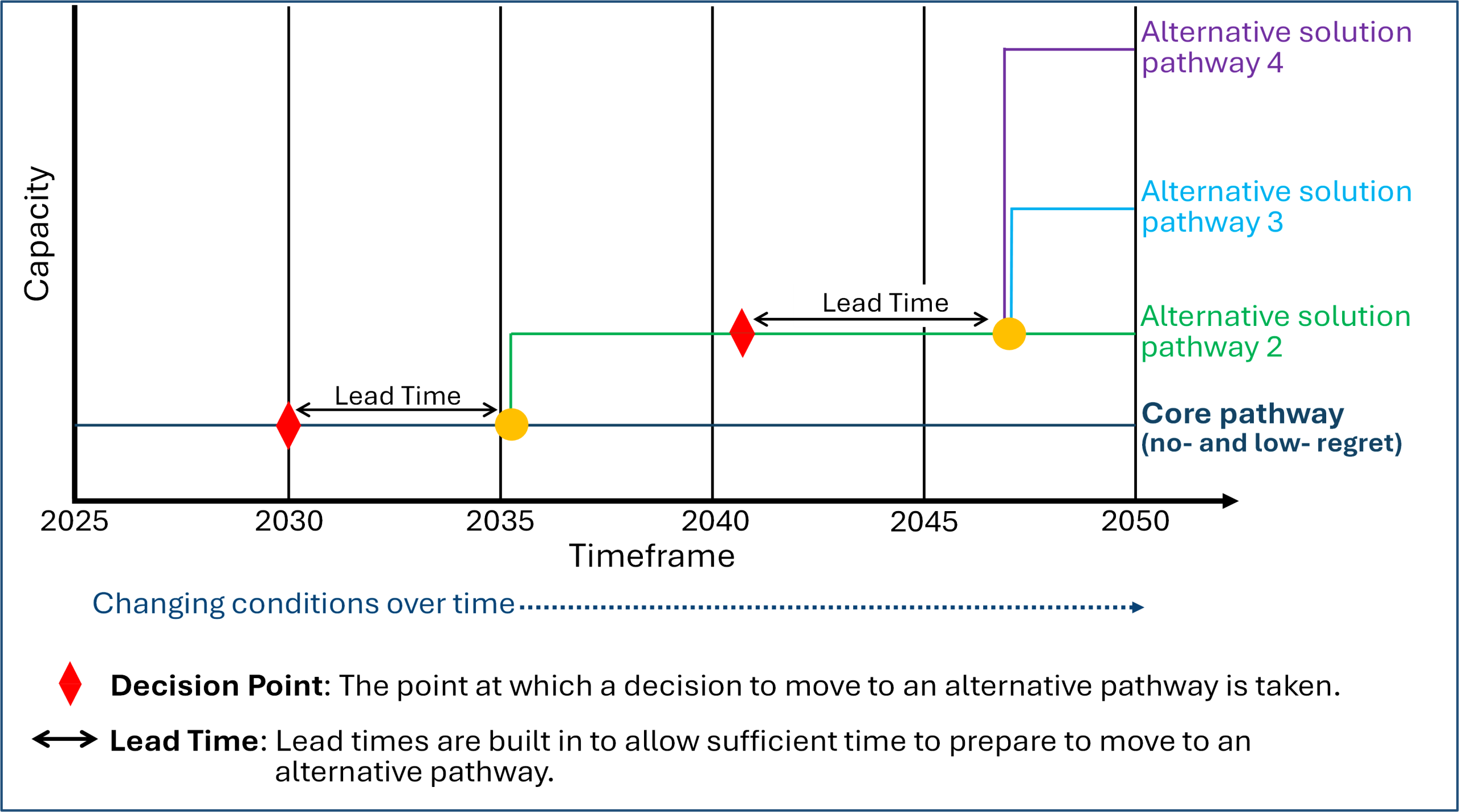
Figure 1: Simplified illustration of an adaptive planning pathway. Utilities establish a core pathway of actions while identifying alternative pathways that may be triggered as conditions evolve. Monitoring and predefined decision points provide sufficient lead time to adjust course before service, financial, or infrastructure risks become unacceptable. Adapted by CWN from Water New Zealand.
What leading utilities are doing
One of the most encouraging findings from CWN’s work is that adaptive is no longer confined to academic research or pilot projects. Utilities across North America, Australia, and Europe are beginning to embed adaptive thinking into their planning and investment processes, and several Canadian utilities are beginning to incorporate adaptive and scenario planning practices.
Urban Utilities in Queensland, Australia, has become one of the most frequently referenced examples within CWN’s Community of Practice. Rather than relying on a traditional “predict and provide” approach, the utility uses scenario planning, adaptive pathways, and investment logic mapping to evaluate future risks and identify flexible responses. The focus is not on selecting a single future but on maintaining the ability to respond as circumstances change.
In the United States, utilities such as Denver Water, Austin Water, Philadelphia Water Department, New York City Department of Environmental Protection, and Portland Water Bureau have each applied AP principles in different ways. Some have focused on water supply resilience while others have incorporated adaptive thinking into long-range capital planning, climate adaptation, watershed management, or enterprise risk management. Whatever the rationale and approach, these utilities are treating uncertainty as a planning input rather than an obstacle.
Portland Water Bureau’s experience provides a particularly valuable lesson. Earlier planning efforts relied on forecasts that anticipated steadily increasing water demand. Instead, population growth continued while water demand declined. The result was a growing recognition that planning systems needed greater flexibility and an ability to respond to changing conditions. This realization helped drive the utility’s transition toward adaptive and scenario planning and ongoing monitoring of key indicators that inform future investment decisions.
Why finance and affordability matter
One of the most significant developments emerging from CWN’s work is the growing connection between AP and financial decision-making.
Historically, adaptive and scenario planning has often been discussed through the lens of climate adaptation or water supply resilience. Increasingly, however, utilities are recognizing its value as a financial risk and asset management tool.
Water infrastructure investments are expensive, long-lived, and often difficult to reverse once constructed. Decisions made today can influence utility finances, rates, and service levels for decades.
AP encourages utilities to prioritize investments that are needed under almost any future while delaying or staging investments that depend on uncertain conditions. This can reduce the risk of overbuilding, stranded assets, premature expenditures, or costly retrofits.
As discussions within CWN’s Community of Practice have highlighted, adaptive and scenario planning is ultimately about improving investment readiness — ensuring that infrastructure decisions are made at the right time and for the right reasons.
One reason AP is attracting attention from utility executives, boards, and finance leaders is its potential to improve the timing of major capital investments. Rather than committing to large infrastructure expansions decades before they may be required, the approach allows utilities to add capacity incrementally as conditions evolve (see Figure 2). This can reduce financial exposure, improve affordability, and preserve flexibility while maintaining service levels.
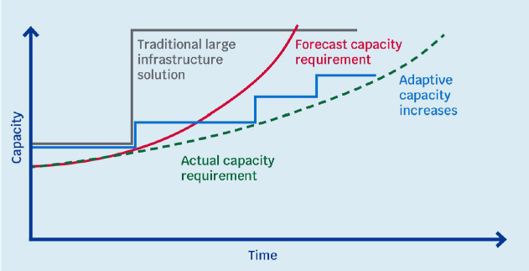
Figure 2: Adaptive versus traditional infrastructure planning approaches.
Traditional planning often requires large investments based on forecasted future needs, while adaptive planning stages investments over time as actual conditions emerge. This approach can reduce the risk of overbuilding, stranded assets, and unnecessary debt while maintaining the ability to respond when additional capacity is genuinely needed. (Source: Adapted from Ofwat PR24 Guidance).
Building adaptive capacity
AP is not a single study or modelling exercise. It’s a capability that develops over time.
The utilities that have made the greatest progress share the following common characteristics:
- Strong leadership support and organizational ownership.
- Cross-functional collaboration between planning, engineering, operations, finance, and asset management teams.
- Ongoing monitoring of key indicators and signposts.
- Integration with capital and asset management planning, and financial decision-making.
- A commitment to continuous learning and reassessment.
Perhaps most importantly, successful utilities view adaptive and scenario planning as an ongoing process rather than a one-time project. As new information emerges, plans are revisited, assumptions are challenged, and investment pathways are adjusted accordingly.
What this means for Canadian utilities
Adaptive and scenario planning is still in its early stages in Canada, but momentum is building.
Through CWN’s AP Community of Practice, utilities across the country are gaining access to practical examples, lessons learned, and implementation strategies drawn from leading experts and practitioners in Canada and internationally.
Adaptive and scenario is not an all-or-nothing proposition. Utilities do not need to completely redesign their planning systems to begin. Many organizations start with a specific challenge, such as a major capital project, a water supply study, a financial plan, or a strategic planning exercise, and gradually build adaptive capabilities from there.
Utilities have always planned under uncertainty. What is different today is the scale and pace of change — shifting growth forecasts, evolving regulations, changing financial conditions, climate impacts and rapid technological developments — are becoming harder to predict. Adaptive and scenario planning does not solve those challenges, but it does give utilities a practical way to respond as conditions change rather than hoping forecasts prove correct.
As water utilities continue to navigate increasingly complex financial, regulatory, environmental, and operational pressures, adaptive planning offers a practical framework for doing exactly that — helping utilities remain resilient, affordable, and prepared for whatever the future may bring.