
Navigating future uncertainty through adaptive planning.
Municipalities across Canada are facing a future characterized by rapid change and growing uncertainty. From climate change to accelerated growth, these complex challenges call for planning approaches that can adapt to changing conditions.
Adaptive planning is a forward-looking and flexible approach that helps decision-makers anticipate a range of possible futures and adjust as conditions change. This inherent flexibility can help minimize investment risks, increase capacity to respond to change, reduce the impact of unforeseen conditions, and maintain reliable water systems.
Canadian Water Network (CWN), with support from Natural Resources Canada (NRCan), is leading a national project to help municipalities plan for a future that is inherently unpredictable. This initiative is designed to increase the capacity of water utilities to anticipate, prepare for and respond to a wide range of future risks.

Benefits of Adaptive Planning
Flexible and Robust Infrastructure Planning
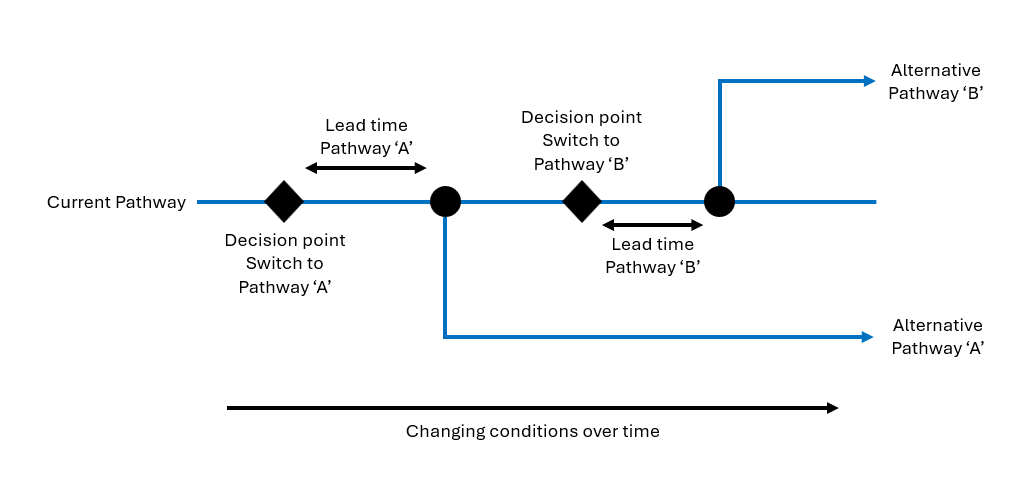
Adaptive planning uses scenario analysis to evaluate plausible future conditions and develop alternative “solution” pathways for each likely scenario. Mapping sequences of suitable options and actions for each selected scenario are used to build alternative pathways. Determining the conditions or indicators that signal when a change in the pathway is needed are used to establish decision points. To allow for sufficient time to prepare for the move to an alternative pathway, lead times are built in.
Unlike traditional planning, which often relies on one prediction that may become outdated, adaptive planning stays flexible and allows for adjustments as things change.
CWN’s Adaptive Planning Project

National Steering Committee
The National Steering Committee plays a pivotal role in guiding the adaptive planning project’s vision and progress. The Committee offers expert insight, fosters collaboration, and helps shape the direction of project initiatives. Members ensure the project remains responsive, inclusive and aligned with long-term goals.