Insights from Singapore International Water Week: Mitigating nitrous oxide in wastewater is no laughing matter
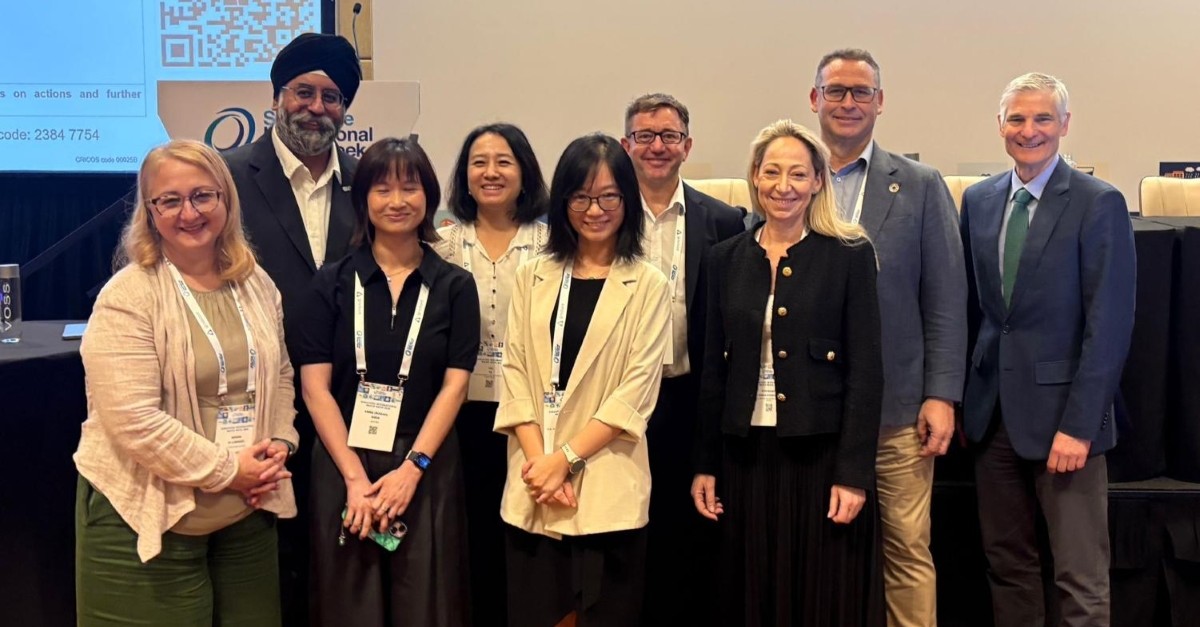
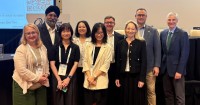
Photo (left to right): Dr. Nerina di Lorenzo, Melbourne Water; Gurdev Singh, Singapore PUB; Emma Shen, Jacobs Canada; Professor Liu Ye, University of Queensland; Yangshuo Gu, Singapore PUB; Dr. Bob Stear, Severn Trent Plc (UK); Stephanie Rinck-Pfeiffer, Global Water Research Coalition; Adam Lovell, Water Services Association of Australia; Peter Grevatt, Water Research Foundation.
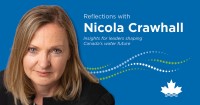
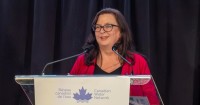
At Singapore International Water Week, Canadian Water Network’s (CWN) CEO Nicola Crawhall attended a fascinating session organized by the Global Water Research Coalition (GWRC) on ‘Advancing Nitrous Oxide Monitoring: Global Protocols, Collaboration, and Pathways to Sector-wide Action.’
Across the globe, many water utilities have committed to achieving net zero emissions by 2030 or 2040. To assist Canadian utilities on the net zero pathway, CWN has been convening two national communities of practice over the past two years. One community of practice brings together utilities just starting out on their net zero journey, and the other brings together utilities that already have a greenhouse gas (GHG) inventory in place. Together, utilities share approaches such as capturing biogas for on-site heat, increasing renewable energy generation, adopting green procurement policies, and optimizing sludge drying and nitrogen removal.
In recent years, as monitoring methods have improved, water utility leaders have become aware that their GHG footprint is likely much bigger than previously assumed. This is due nitrous oxide (N₂O) emissions from wastewater facilities. While nitrous oxide is commonly known as laughing gas, its climate impact is anything but humorous: it is more than 270 times as potent as carbon dioxide. As a result, it presents a serious obstacle on the path to net zero.
This realization drives a critical question: how do utilities accurately measure and effectively mitigate these emissions? The answer begins with better data. Over the last two years, the GWRC, of which CWN is a member, has been working with a team of 60 researchers led by Professor Liu Ye of the University of Queensland to develop a global nitrous oxide monitoring protocol. Now in its final stages, Professor Liu presented the essentials of the guide. Set for release this fall at the International Water Association (IWA) conference in Glasgow, the protocol marks a major step forward in improving our understanding of nitrous oxide and total GHG emissions from wastewater facilities.
Following Professor Ye’s presentation, there was a fascinating discussion on next steps amongst some of the best-informed experts and practitioners in this field. Dr. Bob Stear from Severn Trent Plc said that while monitoring has improved and comprehensive data from numerous wastewater treatment plants are now in hand, our understanding of the dynamics of nitrous oxide emissions is still at an early stage. Practitioners and researchers are trying to determine why there is such great variation in emissions from season to season, plant to plant, hour to hour. Dr. Nerina di Lorenzo from Melbourne Water said that mitigation is incremental rather than game-changing. There are currently limited proven technologies to avoid, reduce or capture process nitrous oxide emissions. “We are in a halfway house at the moment, we are still figuring it out.”
However, Emma Shen of Jacobs Canada argued that we should not wait for a technological fix to be developed. We should arm wastewater operators now with the best available information on specific ‘boring’ operational practices that can reduce nitrous oxide emissions. This includes measures to avoid nitrogen, and reduce the production of, or removing nitrous oxide once produced. Dr. Stear added that feed-forward controls, using predictive models to anticipate disturbances and take corrective action, have proven to be an effective strategy. Documenting and sharing these practices should be made a priority.
Together, these insights underscore both the complexity of the challenge and the urgency of action. While much remains to be learned about N₂O, the sector is already moving forward—combining better monitoring, collaborative research, and practical operational improvements.
Looking ahead, CWN will continue to support this work. Watch for the release of CWN’s net zero water roadmap in November 2027, which will build on global insights like these and help guide Canadian utilities on their path to net zero.